
Neo Deco Interior Design: 6 Stunning Concepts to Transform Your Home in 2026


Walk into any high-end furniture showroom right now, and you will notice a massive shift. The soft, shapeless boucle blobs of the early 2020s are gone. The stark, cold edges of minimalist industrial design are gone, too. We are experiencing a massive course correction in how we want our homes to feel. After years of prioritizing furniture that looked like it was melting into the floor—a direct response to the anxiety of the pandemic era where everyone just wanted to hide in a soft cocoon—we are collectively craving structure again.
Instead of slouch, there is a distinct return to geometry. Sofas have rigidly channeled backs. Cabinets feature ribbed wood detailing. Lighting fixtures look like miniature, glowing skyscrapers.
This is Neo Deco. When *Architectural Digest* and *Pinterest Predicts* named this the defining aesthetic of 2026, they noted how deeply misunderstood it is. Most people hear the word "Deco" and assume it means buying a cheap gold bar cart and hanging a metallic geometric wallpaper. That is how you end up with a living room that feels like a caricature of a 1920s speakeasy.
Neo Deco simply strips away the excessive ornamentation and theatrical glamour of the 1920s original. It keeps the strict geometric silhouettes but executes them in raw, natural, "quiet" materials. It is heavier, and far more livable than its historical ancestor.
If you want to apply this style correctly, you have to understand the underlying mechanics of it. Here are the six core concepts that make Neo Deco work in a modern home.
Concept 1: The Return of the Rigid Silhouette
For the last five years, furniture design prioritized "slouch." Sofas like the famous Restoration Hardware Cloud Sofa dominated the market—deep, overstuffed, covered in wrinkled slipcovers, and requiring constant fluffing. Neo Deco firmly rejects the slouch.
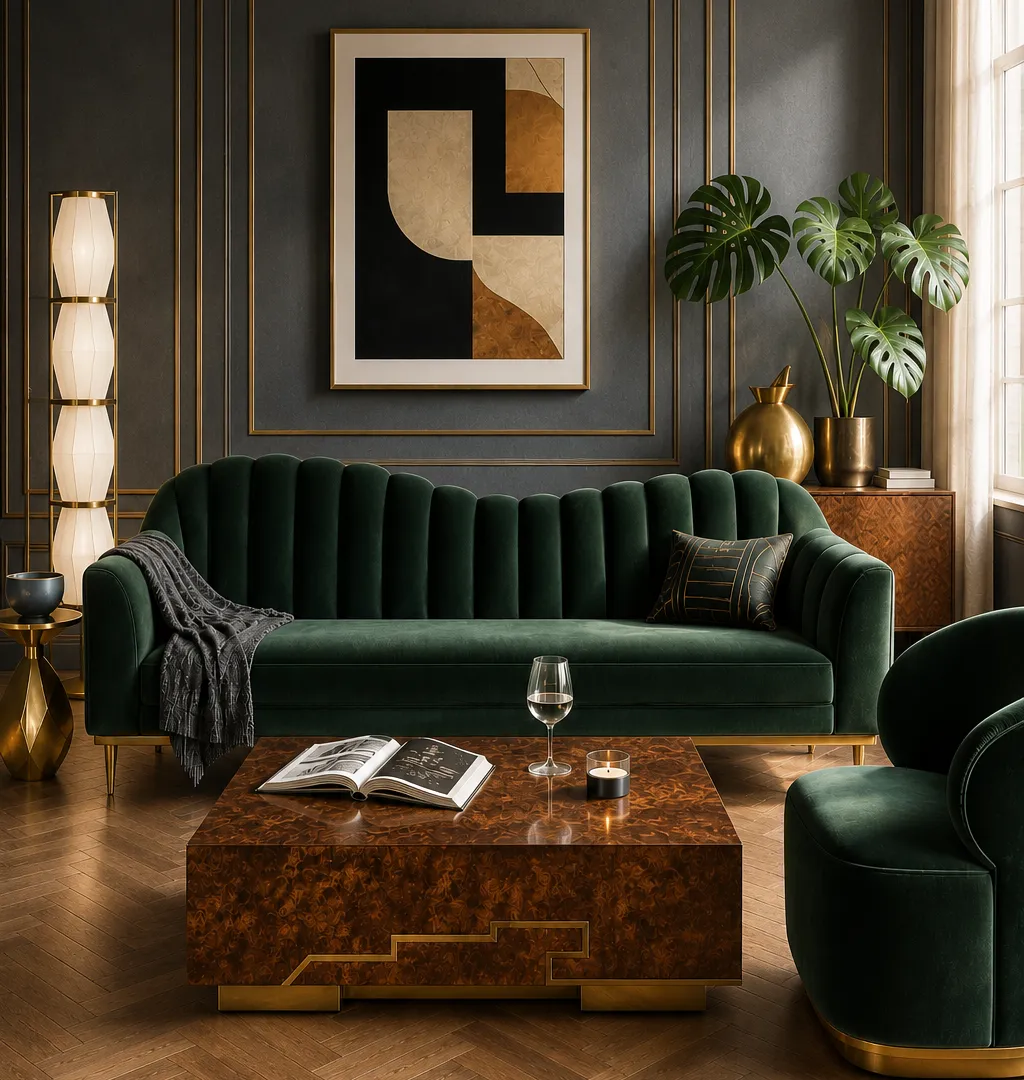
This concept is entirely about visual discipline. A Neo Deco sofa has a tight, tailored back—often featuring vertical channeling or a single, sweeping scalloped edge. It sits low to the ground, and most importantly, it holds its exact architectural shape regardless of who just sat on it. You never have to fluff a Neo Deco chair.
I recently sourced a dark green velvet sofa for a client in Seattle. It had a perfectly rigid, curved frame and absolutely no loose back cushions. The client was panicked, convinced it wouldn't be comfortable for movie nights. I had to explain the mechanics of upholstery to her: a well-built, structured sofa using high-density foam wrapped in a thin layer of Dacron offers infinitely more ergonomic support than a giant pile of goose feathers.
However, you must expect to pay a premium for this structure. A quality tight-back sofa rarely costs less than $2,500 because the tailoring leaves absolutely no room for the manufacturer to hide mistakes. If a seam is off by a quarter of an inch on a tight-back velvet sofa, it ruins the entire geometric illusion.
Concept 2: High-Friction Material Layering
Original Art Deco relied heavily on smooth, shiny surfaces: mirrors, polished chrome, and lacquered wood. That combination feels incredibly cold in a modern residential setting.
Neo Deco relies heavily on "high-friction" materials. Because the furniture shapes are so rigid and strict, if you use flat, shiny materials, the room will feel like a corporate waiting area. You need textures that grab the light rather than reflecting it perfectly to introduce a sense of warmth.
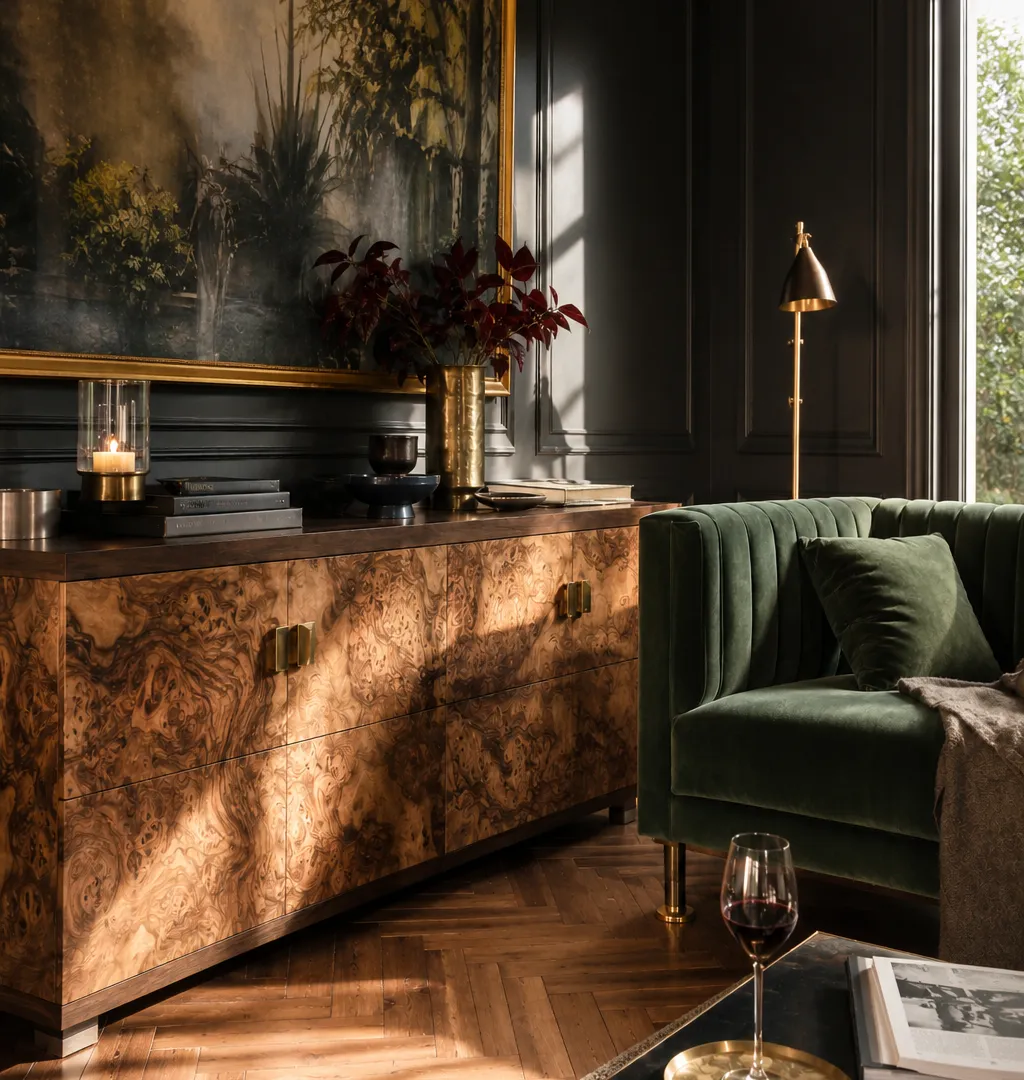
This means swapping out standard flat-weave linen for mohair and heavy performance velvet. Mohair is the ultimate Neo Deco textile—it is incredibly durable, naturally crush-resistant (unlike cheap silk velvets), and it absorbs light, creating deep, rich shadows in the channels and folds of the furniture.
For hard surfaces, instead of the high-gloss black lacquer that defined 1980s Deco revivals, we use burl wood and matte-finished walnut. Burl wood is created from a knotty growth on a tree, resulting in chaotic, swirling grain patterns that look almost like a topographical map. Putting a wild, organic burl wood veneer on a strictly geometric rectangular credenza creates exactly the kind of material tension this style requires.
Finally, we have completely moved away from the ubiquitous brushed gold of the 2010s. Unlacquered brass is the new standard. It arrives shiny but develops a dull, brown-green patina over time as it reacts to the oils in your hands and the oxygen in the air. It shows fingerprints. It ages. If you hate the patina, you can polish it back to a shine with half a lemon and some baking soda, but honestly, that imperfection is what grounds the rigid geometry of the room and makes it feel lived-in.
Concept 3: The Fluted Vertical Line
If there is one specific architectural motif that defines the 2026 iteration of this trend, it is the fluted line.
Fluting—a series of shallow, concave or convex grooves running parallel to each other—originates from ancient Doric columns, but Deco designers adapted it to mimic the soaring vertical lines of early 20th-century skyscrapers. In a modern home, fluting draws the eye upward and visually emphasizes the height of a ceiling. You will see this applied aggressively to the backs of kitchen islands, the fronts of floating bathroom vanities, and as custom wall paneling in dining rooms.
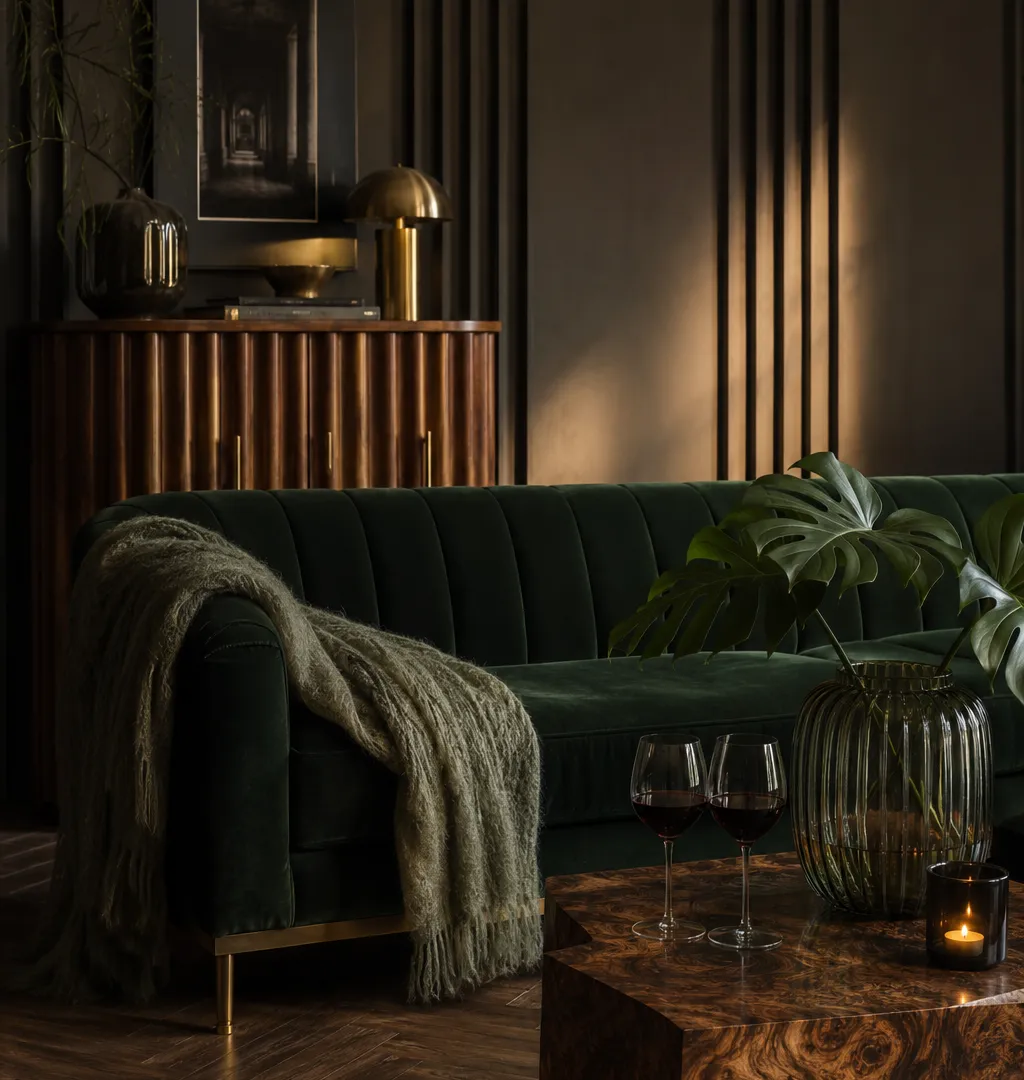
The scale of the fluting matters immensely. A tight, half-inch tambour feels very modern and delicate, while a wide, three-inch scalloped flute feels much heavier and more historically accurate to the 1930s.
The mistake I see constantly on social media is people buying cheap, peel-and-stick fluted panels made of lightweight MDF and wrapping them around a generic IKEA cabinet. It always looks exactly like what it is: a cheap sticker. True Neo Deco requires genuine depth and material integrity. If you cannot afford solid wood tambour paneling or hiring an artisan for custom plaster fluting, do not fake it. Instead, apply the concept elsewhere on a smaller scale. A heavy glass vase with deep vertical ribbing sitting on a table achieves the exact same architectural effect for $80 instead of an $8,000 carpentry bill.
Concept 4: Atmospheric, Directional Lighting
We are completely abandoning the recessed ceiling light. In Neo Deco, lighting is never just functional; it serves two very distinct purposes. During the day, it acts as a heavy sculptural focal point. At night, it creates moody, directional shadows that emphasize the geometry of the room.
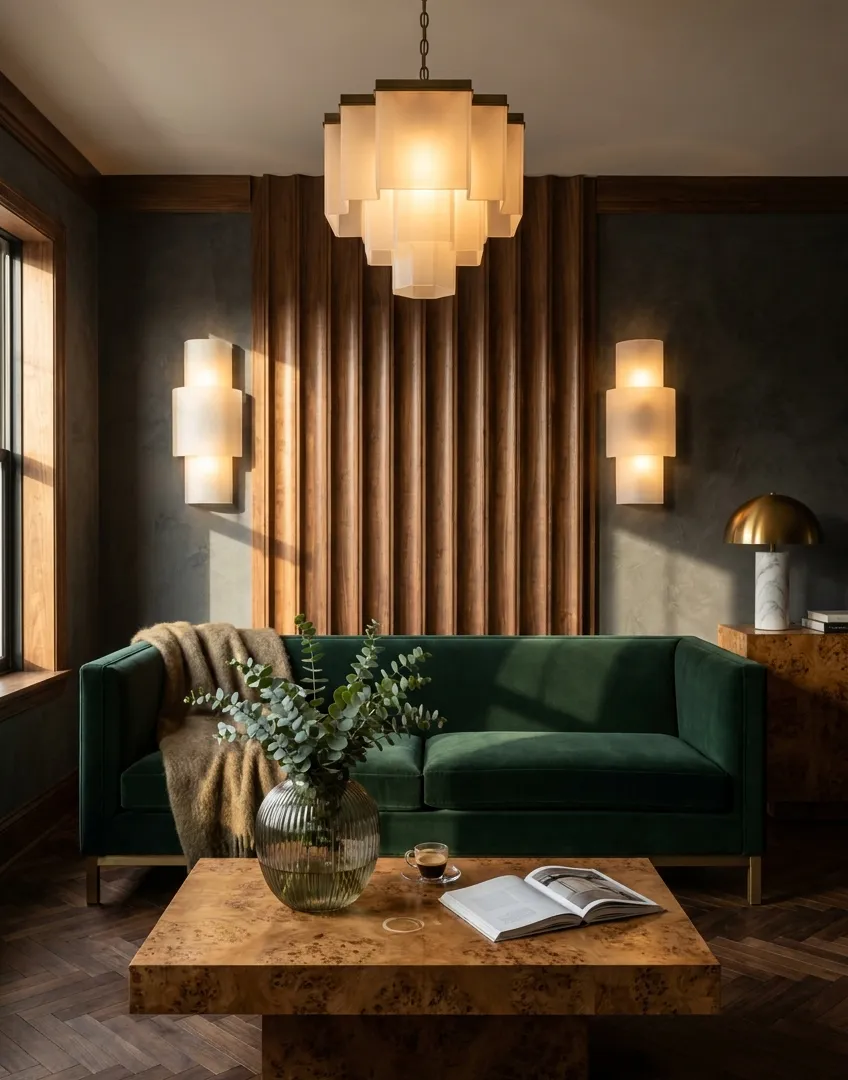
The fixtures themselves must be heavily architectural. Think tiered, frosted glass pendants that literally mimic the setback, step-like design of the Empire State Building. Think heavy, solid marble table lamps paired with opaque brass dome shades that force all the light strictly downward onto a surface, creating intense pools of light surrounded by dark shadows.
Color temperature is critical here. Because frosted glass naturally cools down the light passing through it, you must use 2700K (warm white) LED bulbs. If you use standard 3000K or 4000K bulbs in a Deco fixture, the room will instantly look like a sterile hospital corridor.
I used to think you needed a massive central chandelier to make a statement in a dining room. I was completely wrong. In a recent project, we removed the central ceiling fixture entirely and installed four oversized, frosted glass wall sconces around the perimeter of the room. This lateral lighting strategy grazed the walls, emphasizing the subtle texture of the Roman clay plaster, and optically made the standard 8-foot ceiling feel twice as high.
Concept 5: The "Heavy" Color Palette
You cannot execute Neo Deco in a pastel room. The geometry requires visual weight to anchor it. We are utilizing deeply saturated, "heavy" colors like oxblood, charcoal, olive green, and deep ochre.
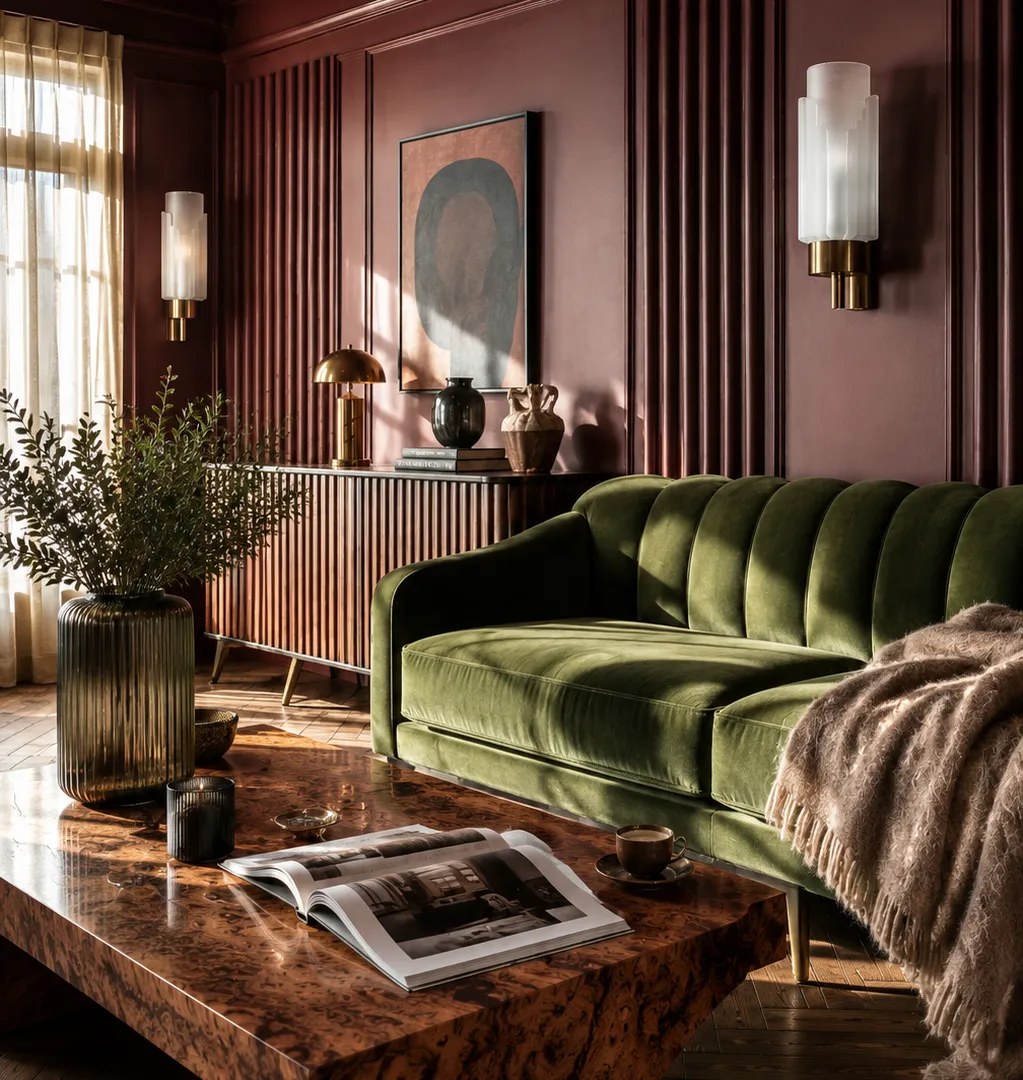
The trick to making these dark colors work without shrinking the room is color drenching. Instead of painting one accent wall, paint the walls, the baseboards, and the window trim in the exact same dark shade. I did this with oxblood in a Seattle townhouse last spring, and the client actually cried when she saw it. She thought a red room would look like a haunted house, but by painting the trim and ceiling the exact same muddy red, we erased the visual boundaries of the room. This allowed the geometric shapes of her new velvet furniture to stand out sharply against the background.
Concept 6: Subtractive Ornamentation
This is the one concept I spend the most time explaining to clients, especially if they are used to the eclectic, heavily layered looks of the past decade. When you are designing a room, the natural human instinct is to keep adding things—more pillows, more books, more art—until the room feels "done" and "cozy."
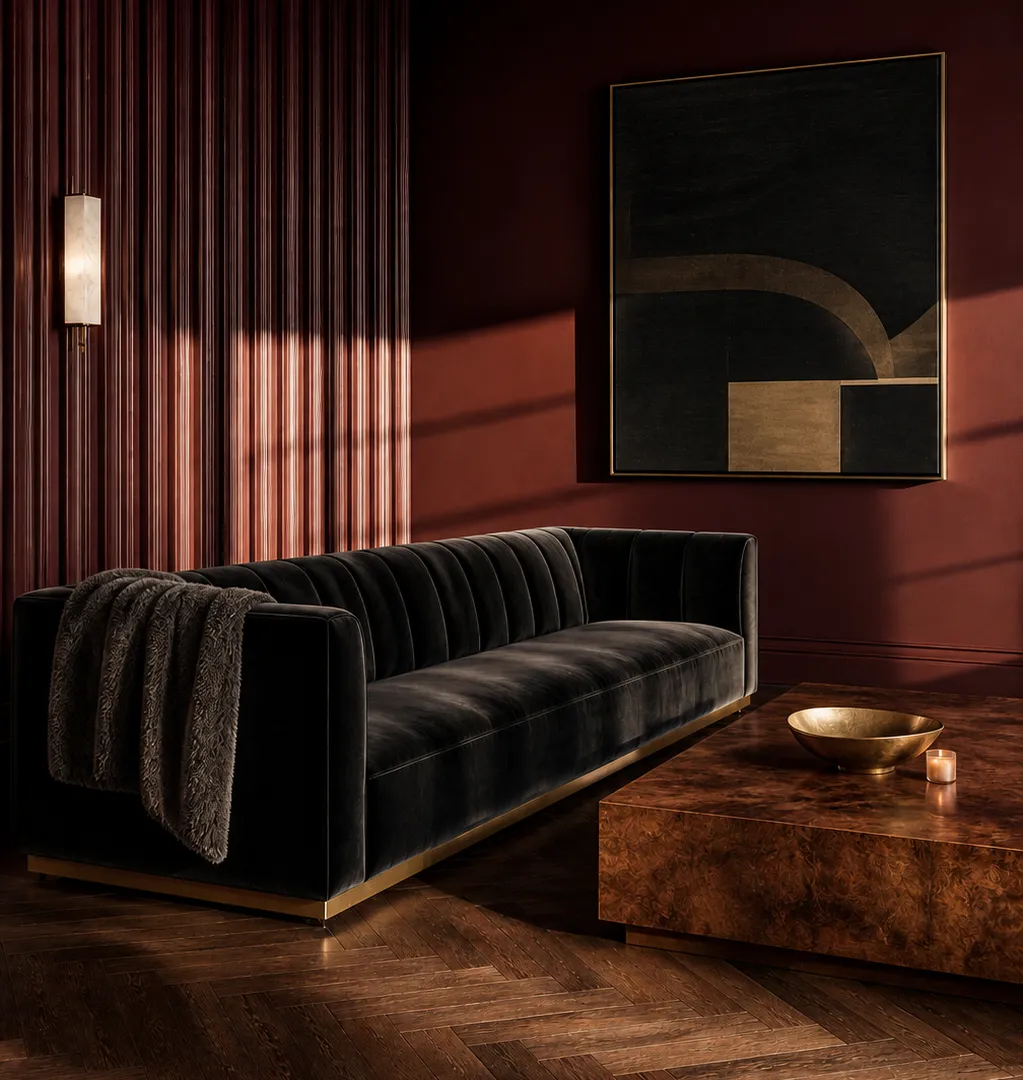
Neo Deco is an exercise in subtractive design. The architecture and the materials used in this style—the swirling burl wood, the heavily veined marble, the ribbed velvet—are so visually loud and demanding that you have to aggressively edit your accessories. You have to start treating negative, empty space as an actual material in your design palette.
If you have a heavily veined Nero Marquina marble fireplace and a strictly channeled mohair sofa, you absolutely do not need a cluttered gallery wall of 15 mismatched small pictures. That creates visual panic. You need one massive, simple piece of art that commands the wall. You do not need a decorative tray full of tiny candles, coasters, and matches on the coffee table. You need exactly one heavy, sculptural bronze bowl.
The ultimate goal of Neo Deco is not to fill the room. The goal is to deliberately create enough empty space around your most expensive, architectural pieces so that their strict geometry can actually be seen and appreciated without distraction.
---
**About the author:** Sarah Jenkins is a former set designer turned residential interior stylist. She specializes in adapting historically heavy design movements for modern, practical households where people actually spill coffee and own dogs.
About the Author: Elena Vance
Interior design enthusiast and DIY expert. Elena Vance has spent over a decade curating spaces that blend modern aesthetics with everyday functionality. Passionate about helping you create a home that tells your unique story.


