Catch the "FunHaus" Wave: How to Turn Your Living Room Into an Inspiring Art Space (2026)
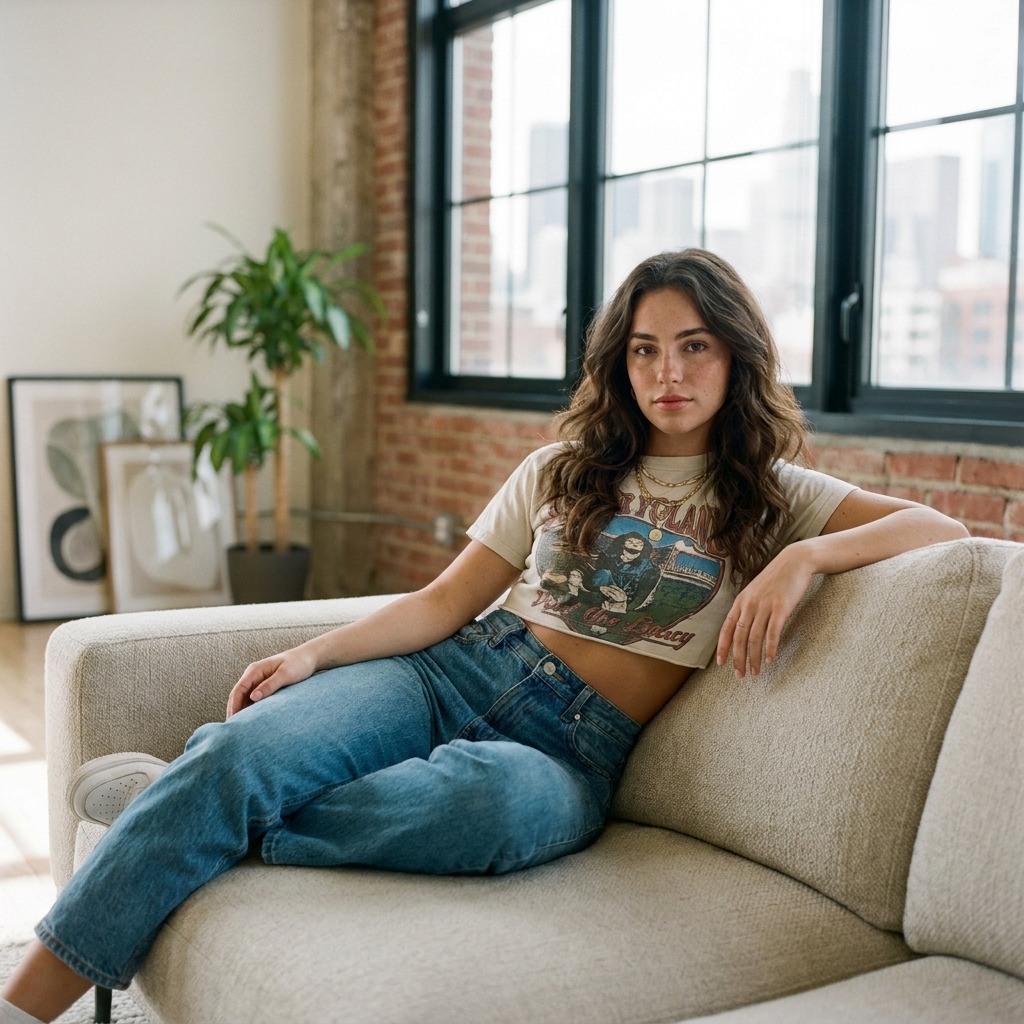

I'll be honest: when I first heard the phrase "circus-inspired home decor," my initial thought wasn't finally. It was more like oh no.
And that's exactly the trap. FunHaus — named by Pinterest Predicts as one of 2026's biggest interior design movements — has a branding problem. The word "circus" triggers images of red and white striped tents, clown figurines, and the particular chaos of a carnival midway. None of that is what this trend is.
What it actually is takes a bit more explaining. And that explanation matters, because the difference between a FunHaus living room that looks like a page out of Wallpaper* magazine and one that looks like someone went rogue at HomeGoods is almost entirely in the logic of how the elements work — not just which elements you choose.
That's the part most articles skip.
What FunHaus Actually Is
FunHaus is a living room aesthetic built on three borrowed tools from classic circus design: high-contrast stripes, sculptural shapes with exaggerated proportions, and saturated color used in controlled doses against a neutral base. The result is "elevated camp" — playful in energy, intentional in execution, and expressive without being exhausting.
It's not Maximalism. That distinction matters more than it sounds. Maximalism says more is more. FunHaus says less, but louder. A well-done FunHaus living room might have only two or three genuinely bold elements — but those elements are chosen and placed so deliberately that the whole room feels alive.
Pinterest's data backs up how fast this is moving. Searches for "circus interior" are up 130% year-over-year, "vintage circus aesthetic" up 70%, "striped ceiling" up 40%. People aren't searching for literal big-top decor. They're searching for rooms that have character — color with an opinion, shapes with a point of view, objects worth looking at twice.4 Ways to Bring the FunHaus Trend into Your Living Room (Without Going Overboard)
The Visual Logic: Why These Specific Elements Work
This is the section almost no one writes. But it's the one that makes everything else make sense.
Classic circus design solved a real practical problem: how do you hold an audience's attention in a large, noisy space with constantly changing natural light? The solutions were visual — high-contrast stripes (the eye picks up sharp edges faster than flat color), curved shapes (the brain reads curves as "safe" and "inviting" more quickly than sharp angles), and saturated color against white backgrounds (maximum contrast at minimum visual cost).
Bring those principles into a living room and they still work — but they work differently. Instead of holding attention to sell tickets, they create the feeling that a room has energy. You walk into a well-done FunHaus space and feel more awake than you did a moment before. A little happier. That's not an accident; it's the same mechanism, redirected.
The problem is that most people copy the style without understanding the logic. They add stripes everywhere, color everywhere, curves everywhere — and instead of stimulating the eye just enough, they overstimulate it. That's the line between "artistic living room" and "exhausting living room." It's closer than you'd think.
The Foundation: Getting Walls and Floors Right Before Anything Else
Before you buy anything with a stripe or a saturated color, look at your base.
The 80/20 rule gets cited constantly in FunHaus articles — 80% neutral, 20% bold. But that's not specific enough to be useful, because the type of neutral matters enormously.
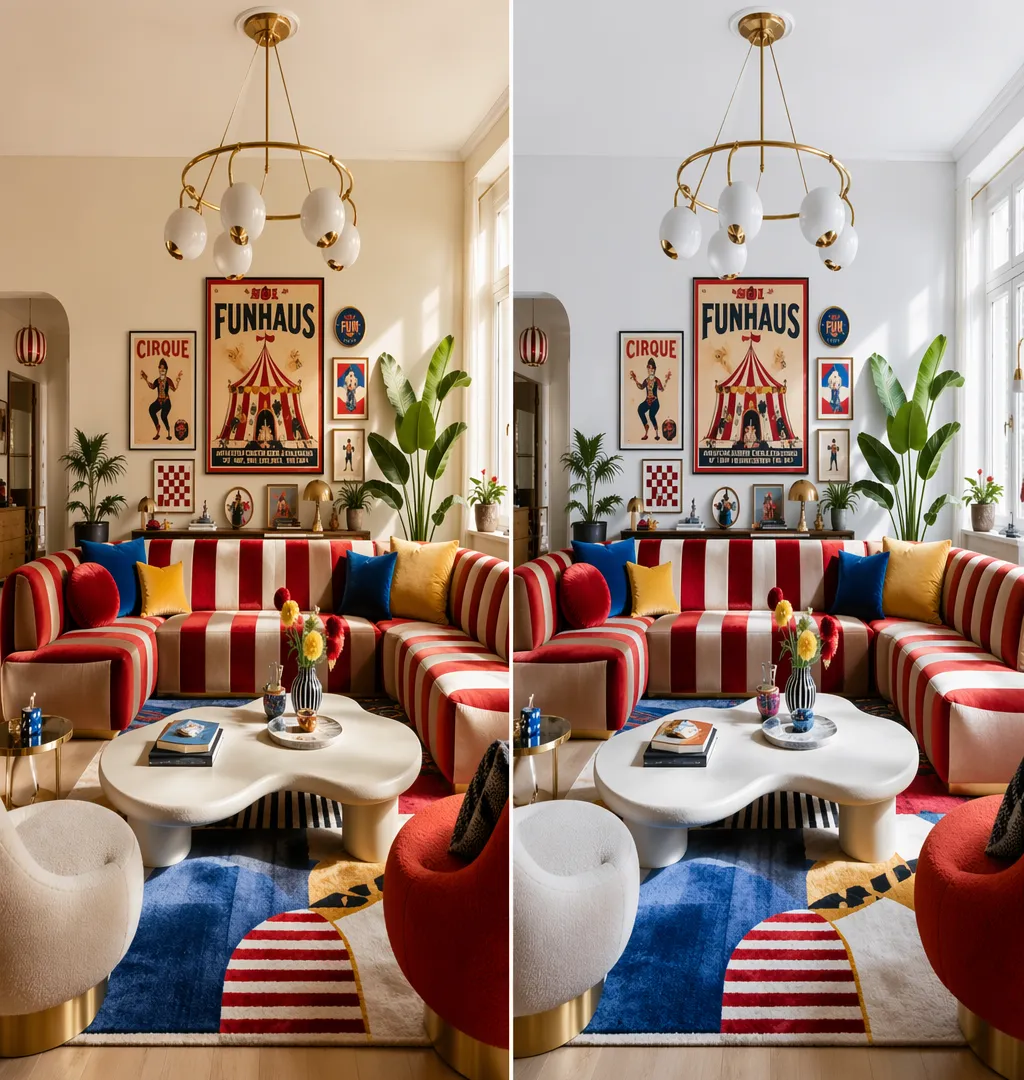
Warm white walls — think Benjamin Moore White Dove (LRV 85.9) or Sherwin-Williams Alabaster — are the most forgiving FunHaus base. They make mustard yellow, brick red, and deep teal read as intentional and warm rather than jarring. If you're planning a room with jewel-toned furniture, start here.
Cool white — Farrow & Ball All White or similar — works beautifully for the black-and-white-plus-one-accent version of FunHaus. It creates a gallery-like quality that lets the bold pieces feel like art objects rather than furniture. The risk: it can feel cold if you don't have enough warm texture to counterbalance.
Cream and off-white sit between the two. Safe, readable, works with most FunHaus palettes — but flat if there isn't enough contrast in the bold elements to pull the room forward.
Flooring: if you have warm-toned wood floors, that's your advantage. Natural wood ground the room and stops bright colors from tipping into cartoon territory. Cool-toned tile or vinyl works fine, but you'll need a rug to add warmth — which you probably want anyway.
Stripes — The Soul of the Trend and the Most Common Mistakes
Every FunHaus article mentions stripes. Fewer of them tell you how to use them without making your living room look like a barbershop pole exploded.
The most common mistake: putting stripes on too many surfaces at once. Striped wall plus striped rug plus striped throw pillows plus a striped lampshade — your eye doesn't know where to land. The room feels busy instead of bold. There's a meaningful difference between those two.
The rule: one dominant surface, one stripe, let it breathe.
A striped area rug is the lowest-commitment, highest-impact choice. A large black-and-white horizontally striped rug — 8x10 feet or bigger — anchors the whole seating area without taking up any wall real estate. It's also the easiest way to test whether FunHaus actually works in your specific space before committing to anything structural. If you hate it, you roll it up.
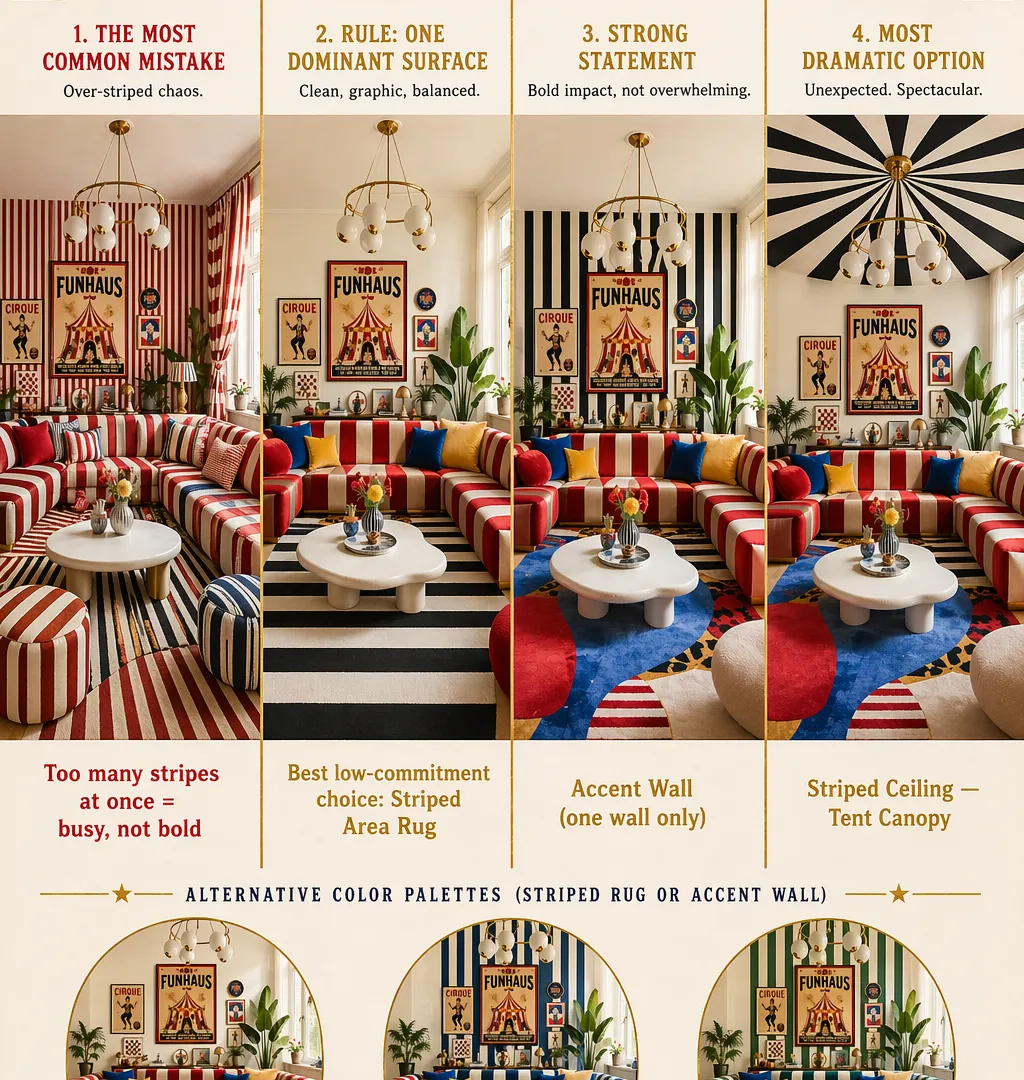
An accent wall with stripes is a stronger statement. If you go this route: one wall only, ideally the wall behind the sofa or the one facing the main entrance. Stripe width matters — 4 to 6 inches is the sweet spot. Narrower and it reads retro-80s. Wider and it loses the graphic tension that makes it interesting.
The striped ceiling. This is the most dramatic option and also the one that genuinely surprises people in person. The "tent canopy" technique — painting radiating stripes out from a central light fixture — brings the whole circus-dome reference into the room in a way that's unexpected and, honestly, kind of spectacular when done right. Keep the surrounding walls completely white. The ceiling is doing all the work.
One more thing about stripe color: it doesn't have to be black and white. Barn red and cream. Deep navy and warm white. Forest green and ivory. What matters is that the contrast is high enough for the stripe to read as intentional. Soft blue stripes on a pale background slide into Scandi territory. That's a different aesthetic entirely.
Sculptural Furniture: Curved Isn't Enough
This is where most articles stop too soon.
"Curved furniture" is technically right but not specific enough. FunHaus has a particular relationship with proportion — it prefers curves that are exaggerated. A sofa with a slightly rounded back isn't really FunHaus. A sofa with a dramatically high, rounded backrest — or a coffee table so chunky and round it looks like an oversized marshmallow — that's the shape language the style is actually speaking.
Why exaggerated proportions? Because FunHaus borrows from circus geometry: tent poles, domed tops, spheres, hourglasses. When you put a bubble-shaped chair in a living room, it's not just "a chair with curves" — it's a shape that reads as familiar (chair) and slightly uncanny (not quite right) simultaneously. That mild visual tension is where the character lives.
Some specific directions:
A barrel chair or egg chair in a solid jewel tone — dusty gold, teal, deep persimmon — does more work per square foot than almost anything else you could add to a room. Urban Outfitters' Rhea Swivel Chair runs around $499 and comes in several stripe and solid options. Anthropologie's curved lounge chairs hover in the $600–900 range. Worth it, if you pick one strong piece and let it be the character.
A chunky cylindrical coffee table in white or cream: balances the bold elements without competing with them. Look for solid wood or concrete rather than acrylic — the material weight matters for keeping the room grounded.
A geometric pouf instead of a second accent chair: flexible, moveable, adds a color note without the permanence. And at $80–200, it's the easiest way to introduce a second saturated color without the commitment.
Not everything needs to curve dramatically. One or two genuinely sculptural pieces are enough. If the sofa, chairs, table, and pouf are all rounded and puffy, the room loses its sense of being anchored — everything starts to feel like it's floating. You need something with a clean line somewhere to give the curved pieces something to push against.

Lighting and Mirrors: The Two Things Most Rooms Skip
Most FunHaus guides treat lighting as an afterthought. A striped lampshade gets mentioned. And that's about it.
But lighting is where the difference between a FunHaus room that photographs well and one that feels right in person gets decided.
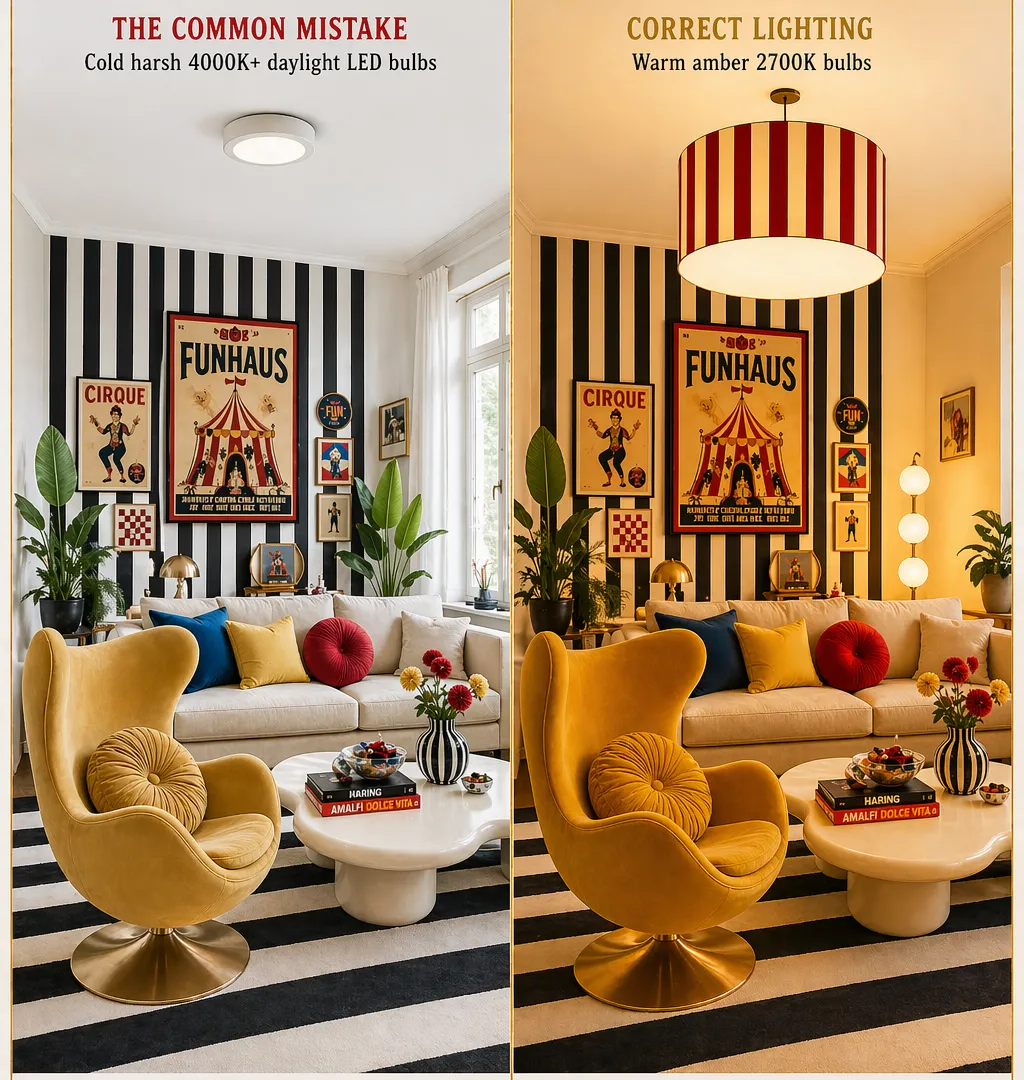
Bulb temperature first. Any LED over 3000K (daylight-leaning white light) kills warm FunHaus colors. Mustard yellow under 4000K light looks washed-out and slightly sickly. Deep teal looks faded. Get bulbs in the 2700K range — the warm amber end — and your saturated colors will sing. This costs nothing to change and has a larger effect than most furniture decisions.
Fixture shape matters. FunHaus doesn't require a Sputnik chandelier (though a Sputnik chandelier does read FunHaus immediately). What it does require is a fixture with a silhouette that's worth looking at — something either dramatically oversized for the space, unexpectedly low-hanging, or with a shade that has pattern or texture. A striped drum pendant shade is the fastest FunHaus signal you can add to a ceiling. Floor lamps with sphere bases or hourglass stands add vertical interest without taking surface space.
On mirrors: the "puddle mirror" — a rounded, irregularly edged mirror with an organic silhouette — is the FunHaus mirror of choice right now, and for a good reason. Its asymmetric curve creates natural contrast against straight-edged architecture and striped patterns. A room full of bold stripes and geometric shapes needs something that doesn't share their rigid geometry to feel visually complete.
Lean a large puddle mirror against a striped accent wall rather than hanging it. The lean feels deliberate. The slight forward tilt reflects different parts of the room depending on where you're standing, which adds that subtle visual surprise FunHaus lives on.
A funhouse mirror — wavy, shape-distorting — can work, but use one maximum. More than one and the room tips from "art installation" to "literal funhouse." Which, again: different thing.

When FunHaus Fails: The Traps No One Talks About
I want to be direct about this because the usual advice isn't.
Too many patterns competing simultaneously. Striped wall plus checked pillows plus harlequin rug plus geometric art equals a room where nothing wins. Pattern needs a hierarchy: one primary (stripes), optionally one secondary at a small scale (a single checked cushion, a tiny geometric detail on a lamp base), and everything else in solid. When every surface is patterned, the eye can't rest — and a room the eye can't rest in is a room people don't want to spend time in.
Color without an anchor. Red pillows, blue lamp, yellow pouf, purple throw — each of those is a FunHaus color. All four together without repetition is visual chaos. Choose one or two accent colors and repeat them: mustard on the chair, mustard echoed in a single vase, a smaller mustard cushion. The second color (say, deep red) appears once only, as the final accent. Repetition creates intention; scattered color creates noise.
Decor that's too literal. Clown paintings. Actual vintage circus posters featuring performers. Miniature big-top figurines on every shelf. This is where FunHaus becomes a theme, and a theme is not the same as a style. The reference to circus should be abstract — expressed through geometry, color, and proportion, not through iconography. A bold pop-art canvas in primary colors is FunHaus. An actual poster from a 1920s travelling circus show is vintage (different category), and six of them on one wall is a collection, not a living room.
Cheap materials. This one matters more than people expect. FunHaus is "elevated camp" — the elevated part is load-bearing. A sapphire blue velvet cushion with a silk fringe trim is FunHaus. The same shape in polyester is a prop. The bold colors and unusual shapes that define this style need quality materials to read as intentional rather than accidental. If the budget is limited, buy one genuinely good piece — a real wool rug, a solid wood side table, a well-made chair — rather than several inexpensive pieces that collectively drag the room down.
How to Start If You're Not Ready to Commit
You don't need to repaint anything to test whether FunHaus works for you.
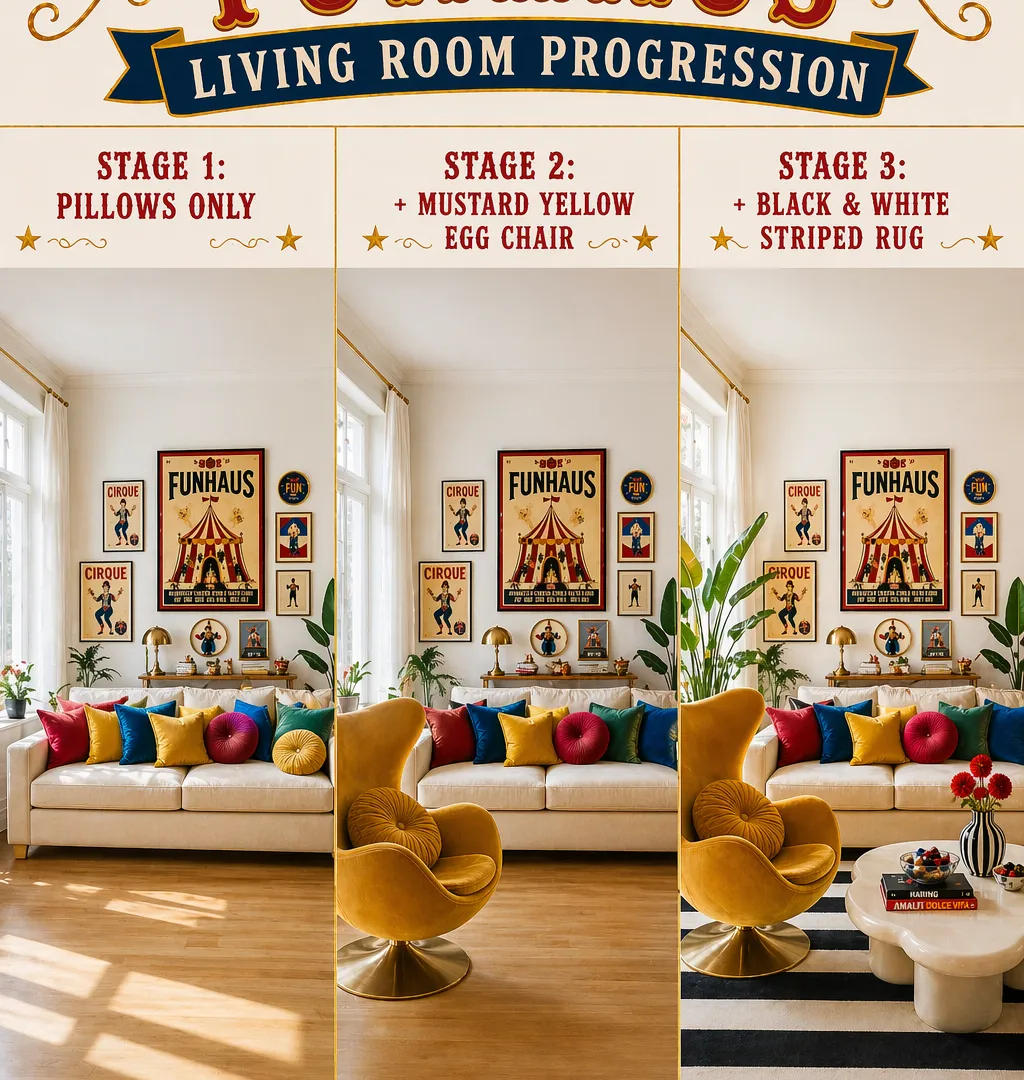
No-commitment entry: Add two or three solid jewel-toned throw pillows to your existing sofa. Emerald, sapphire, burgundy, or mustard — pick one color and get two to three pillows in variations of it. The room will change immediately and noticeably. If you don't love it in two weeks, it cost you under $100 and you return them. If you do love it, you've confirmed your color direction before buying anything larger.
One statement piece: A barrel chair or rounded accent chair in a saturated solid color. This is the piece that makes a room start speaking the FunHaus language. The chair becomes the focal point; everything else organizes around it. Budget: $300–800 depending on material quality. Worth prioritizing spend here over anywhere else.
The structural commitment: Once you've confirmed through the first two steps what the room actually wants, a striped rug or a striped accent wall locks in the visual foundation. A good wool striped rug in the 8x10 range runs $400–700. A painted stripe wall costs the price of two cans of paint and a weekend. Both are far less permanent than they feel before you do them.
The one thing I'd tell anyone starting out: let the room sit for a week between additions. FunHaus over-decorating is the most common failure mode — and it happens because people add everything at once and can't see where the room peaked. Add one element, live with it, then decide what's actually missing.
FunHaus isn't for everyone. It shouldn't be. But if you've been sitting in a room that's technically fine — quiet, composed, inoffensive — and feeling like nothing about it reflects who you actually are, this is the year the design world is explicitly giving you permission to try something different. Not something loud. Something that has a point of view.
There's a difference between a room that shouts and a room that speaks with confidence. FunHaus, done well, is the second one.
Frequently Asked Questions
About the Author: Elena Vance
Interior design enthusiast and DIY expert. Elena Vance has spent over a decade curating spaces that blend modern aesthetics with everyday functionality. Passionate about helping you create a home that tells your unique story.


