
Afrohemian: Bringing the Warm "African Soul" Into Your Living Space in 2026


The beige living room was safe. Too safe. It looked exactly like the Pinterest board you saved three years ago. But after living in it for six months, it didn't feel like a home—it felt like a waiting room for someone else's life.
That is the inherent problem with the mass-produced Scandinavian cycle we all bought into for a decade. We aggressively optimized for clean lines. We stripped out the narrative. We erased the friction that makes a room feel human.
Then came the overcorrection. People reacted by buying fringe pillows, mass-printed macrame wall hangings, and suddenly the living room looked like a cluttered music festival tent. There's a middle ground that the 2026 interior design world is finally catching onto, and it completely bypasses both the sterile and the chaotic.
It brings actual warmth back into our homes. It demands real texture.
It is Afrohemian.
What is Afrohemian? Where Heritage Meets Free Spirit
Afrohemian is an interior design style that blends traditional African craftsmanship and materials with the relaxed, unstructured layout of bohemian decor. It relies on deep earth tones, raw textures like handwoven mudcloth, and carved woods to create a grounded, culturally rich aesthetic.
The snippet version is easy to grasp. The execution is where most people get it entirely wrong.
Traditional boho often drifts into a visually noisy territory. It leans heavily on airy, light elements—white walls, endless draping plants, and thin rattan. Afrohemian (or Afro-boho) pulls that floating aesthetic firmly back down to earth. This design language celebrates the exquisite craftsmanship of African artisans, the sun-baked colors of the savanna, and intricate woven patterns that actually carry deep historical meanings rather than just looking vaguely "tribal."
If "FunHaus" is that colorful, bustling art party happening down the street, Afrohemian is the quiet, immensely soulful conversation by a fire. As we increasingly crave spaces that offer psychological healing and a genuine connection to organic materials, this isn't just a seasonal catalog update. It is a way of storytelling through the objects we choose to live with.
4 Core Elements to Curate an Authentic Afrohemian Space
The difference between buying into a superficial trend and genuinely adopting a design language lies in the foundation. You don't achieve this look by tossing a zebra-print throw over a generic gray sofa. To seamlessly weave the Afro-boho breath into your house, you have to nail the architectural base.
1. Earthy & Grounding Palette
he colors of Afrohemian are directly pulled from unpaved earth, crushed minerals, and untamed landscapes.
Most people are terrified of dark, warm colors. They default to "Decorator's White" because it feels foolproof. But a stark white room lacking architectural interest reads as cheap, not chic.
Ditch the glaring neons. Step away from the cool, blue-based grays that have dominated flipped houses for years. Put down the pastel swatches. Instead, embrace tones that absorb light rather than aggressively reflecting it: terracotta, ochre (mustard yellow), burnt orange, and oxidized rust.
If you are standing in a paint store right now feeling overwhelmed by swatches, look at the LRV (Light Reflectance Value) printed on the back. Sherwin-Williams' Cavern Clay has an LRV of 38. That means it absorbs a massive amount of light, creating a room that wraps around you like a heavy blanket.
Anchor these vivid, deeply saturated hues with structural neutral bases like warm sand, unbleached linen off-white, or rich dark brown. Then, let deep botanical greens—the actual plants, not just paint—serve as the life-giving accent color.

2. The Power of Patterns & Textiles
The most significant differentiator of Afro-boho lies in its textiles. This is where the cultural narrative is spoken aloud.
When you buy a digitally printed pillow from a big box store featuring a generic "global" pattern, the fabric is perfectly smooth. It lacks the slub, the warp, the slight inconsistencies of human hands. It reads immediately flat.
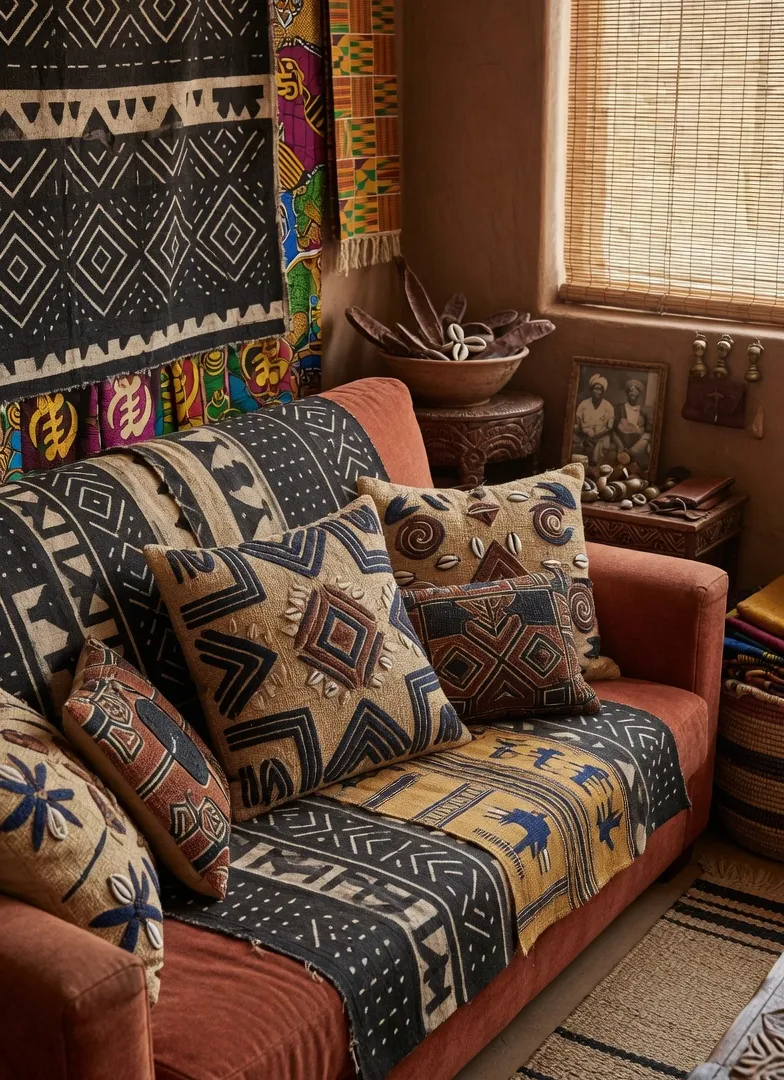
Authentic textiles have weight. Drape a piece of genuine Mudcloth (Bògòlanfini)—a handwoven Malian fabric dyed with fermented river mud—over the foot of your bed. The striking black-and-white or earthy brown geometric patterns aren't just decorative; historically, these symbols told stories of historical events or offered protection.
Incorporate throw pillows made from Kuba cloth. Originating from the Democratic Republic of Congo, this fabric is woven from the leaves of the raffia palm tree. It has a unique, raised woven texture that feels almost architectural. The rawness of these organic materials brings an incredible, tactile luxury to the room. They don't just sit on a sofa; they demand to be touched.
3. Natural Materials & Rustic Furniture
Afrohemian design respects a tree for being a tree. It loves elements in their most natural, minimally processed state.
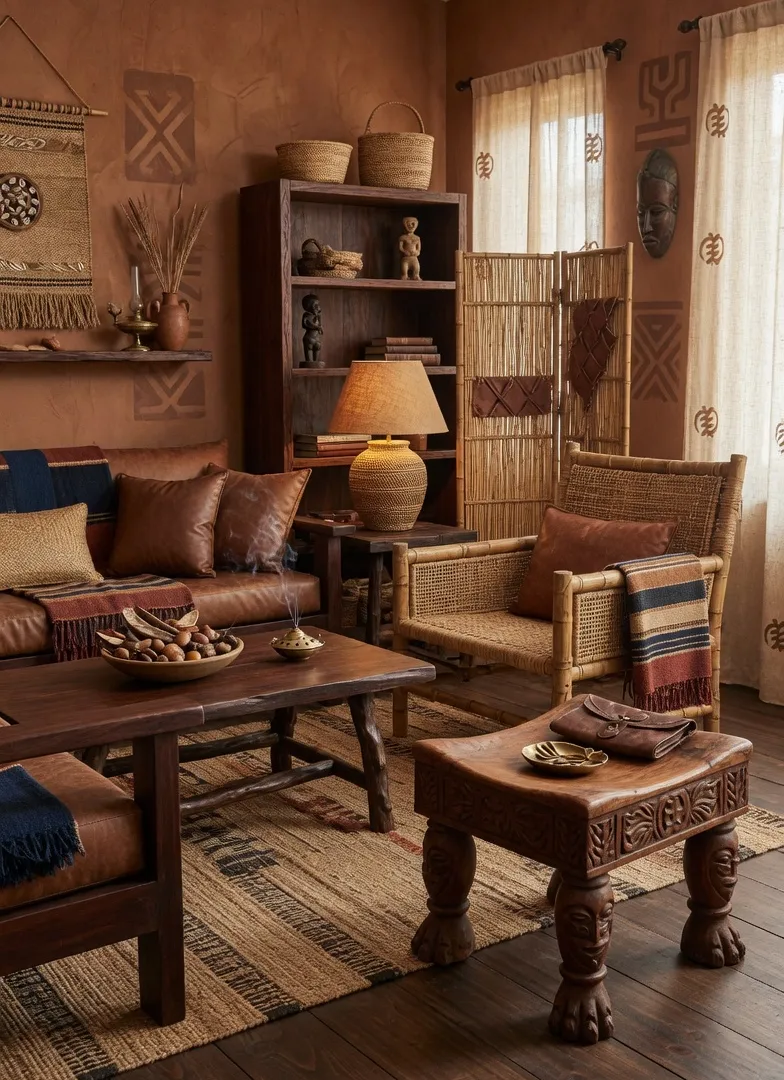
For the last ten years, pale blonde woods like white oak and ash ruled the internet. They look great in a minimalist loft, but they often lack visual gravity. Afrohemian flips that script. Prioritize undeniably dark wood furniture—walnut, heavy mahogany, or charred teak—to forge a striking, moody contrast against your warm terracotta color palette.
Wood this dark will show dust faster. That's real. But it also grounds a large living room entirely on its own.
Incorporate woven details crafted from rattan, thick bamboo, palm strips, or full-grain natural leather. Don't use rattan for everything; use it strategically to break up the visual weight of the heavy woods. A solid, hand-carved wooden piece—like an authentic Senufo stool from Ivory Coast with its thick, tapered legs—serves as an excellent signature item. It functions as seating, a side table, or simply sculpture.
4. Artisan Crafts & Large Greenery
An Afro-boho sanctuary completely fails if it lacks natural vitality. You cannot build this style using only dead materials. It requires a biological element and handcrafted art.
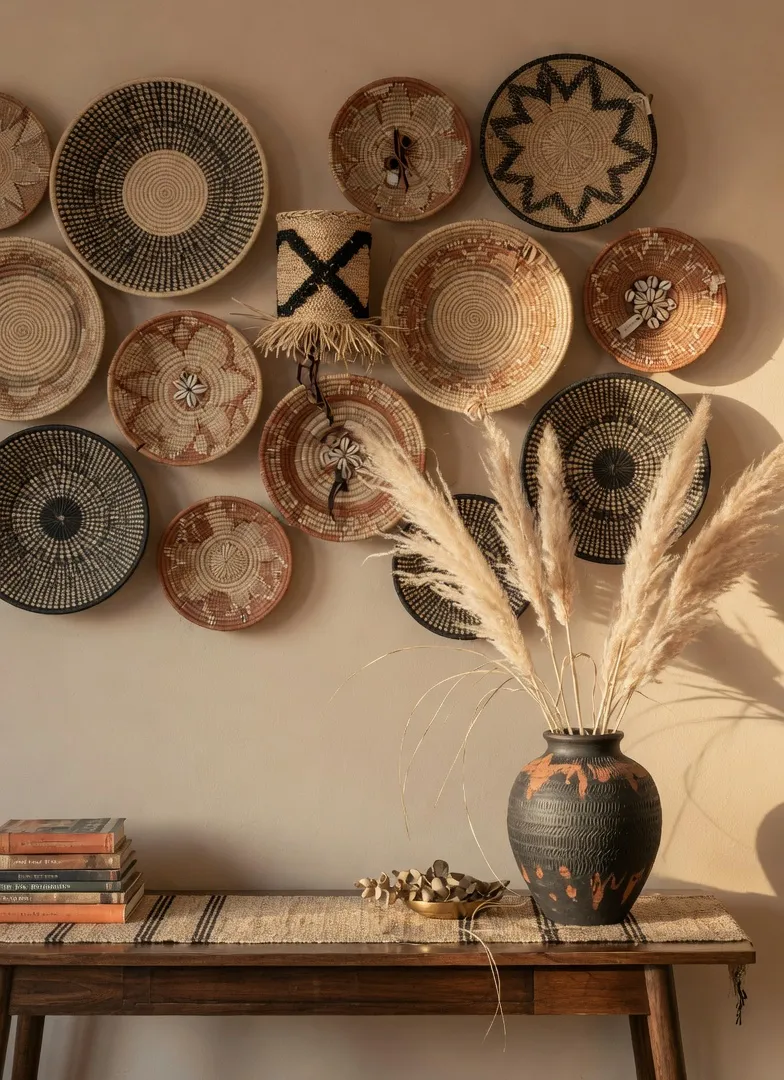
Standard framed art prints bought online offer a flat, two-dimensional experience. Elevate your wall decor by hanging a curated collection of handwoven sweetgrass baskets from Rwanda. They project off the wall, casting fascinating, shifting shadows as the sun moves across your room throughout the day.
Display raw, unglazed ceramic sculptures or tribal wooden statues on open shelving. Keep them grouped intentionally—a cluster of three varied heights reads as a collection, while one item per shelf just looks like forgotten clutter.
Most importantly, aggressively bring the outdoors in. Scale matters here. A few tiny succulents on a windowsill won't cut it. You need large, structural, statement plants. Grab a massive Bird of Paradise, an architectural cactus, or a mature rubber tree to create a lush, tropical oasis feel. (And a quick warning on the Fiddle Leaf Fig everyone loves: they are notoriously finicky and drop leaves the second they face a draft. If you lack direct sunlight and patience, go with a Monstera Deliciosa instead.)

The Basket Wall
Gallery walls made of matching square frames often end up looking like a dentist's hallway if the art isn't deeply personal. The basket wall is the three-dimensional, highly textured alternative.
It looks effortless online. It is rarely effortless to install.
If you just start hammering nails, you will end up with a scattered, unbalanced mess. Map it out on the floor first. Start with the largest, most visually heavy basket—but never place it dead center. Offset it slightly to the left or right to create dynamic tension. Then, radiate the smaller baskets outward, allowing them to overlap slightly. They shouldn't float an isolating three inches apart. Let the edges touch. Let them interact.
When installed correctly, a collection of African sweetgrass or sisal baskets behaves like a single, massive piece of woven sculpture.
The Earthy Bedroom Sanctuary
Bedrooms are incredibly prone to feeling flat. You put a mattress on a frame, you pull a flat duvet over it, you center a rug underneath. It's a series of rigid rectangles.
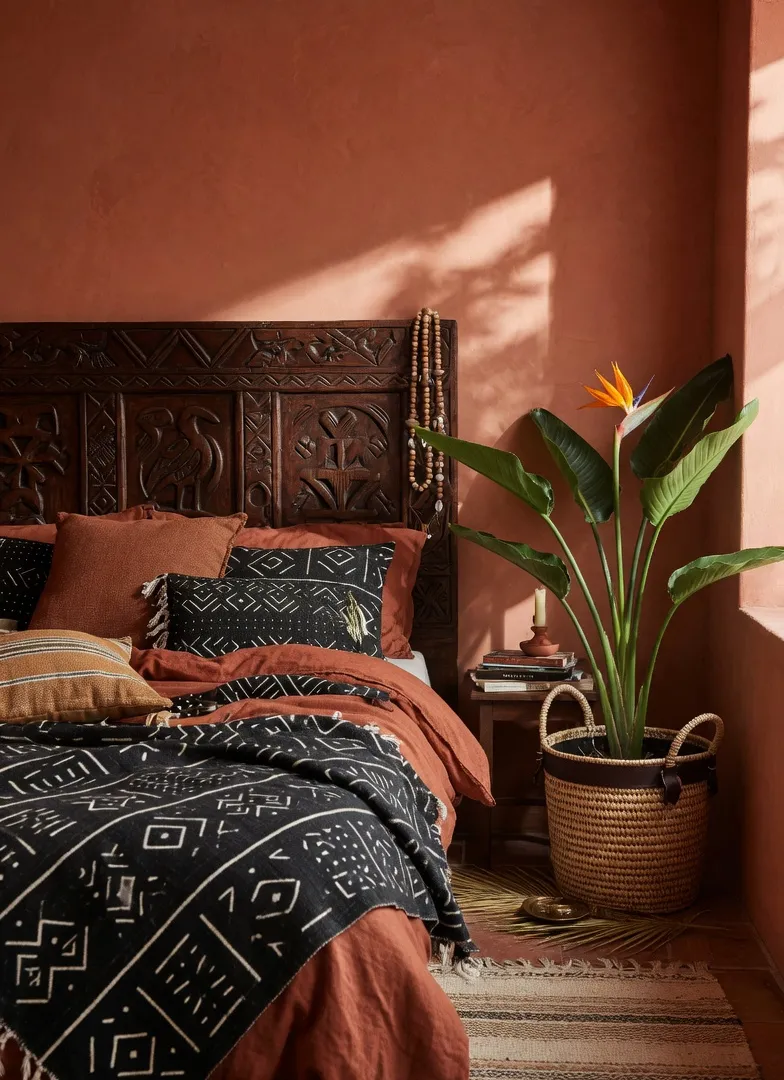
The Afrohemian bedroom breaks those severe geometries through aggressive, intentional layering.
Start by stripping out any clinical white lighting. Swap your bedside lamps for bulbs specifically in the 2700K range to mimic the warmth of candlelight. A bedroom lit with a 4000K daylight bulb will never feel like a sanctuary, no matter how much linen you buy.
Layering is the crucial mechanism here. Over your organic linen duvet, drastically change the texture at the foot of the bed. A heavy, raw-edged Bògòlanfini throw instantly kills the "hotel room" vibe. Add two oversized European pillows wrapped in textured Kuba cloth against the headboard. The goal isn't to create a perfectly tucked military bunk; the goal is to build a bed that looks like it wants to pull you in.
The Cozy Reading Nook
You cannot force comfort. You have to engineer it.
An orphaned armchair shoved into an empty corner isn't a reading nook. It's just a chair in timeout. To create an authentic Afro-boho micro-space, you have to define the psychological boundary of the corner.
Start with seating that forces you to lean back. A low-slung, worn leather butterfly chair or a heavy, cane-backed lounge chair works perfectly. Anchor it instantly with a small, deeply piled rug—perhaps a Moroccan Boucherouite—specifically for that corner.
The lighting dictates the mood entirely. Relying on overhead ceiling cans will destroy the intimacy of a reading nook. Bring in a heavy floor lamp with a woven rattan shade to cast heavily patterned, ambient shadows against the wall. Drape a thick, coarse blanket over the arm of the chair. It tells anyone walking past the room exactly what that space is intended for.

Frequently Asked Questions
About the Author: Elena Vance
Interior design enthusiast and DIY expert. Elena Vance has spent over a decade curating spaces that blend modern aesthetics with everyday functionality. Passionate about helping you create a home that tells your unique story.


