
Neo Deco Bathroom: Materials, Color, and How to Actually Do It


There's a reason Pinterest gave this one its own name.
After nearly a decade of bathrooms drowning in white subway tile, cool gray stone, and fixtures that looked interchangeable with a hotel gym — people got tired. Not tired of luxury. Tired of anonymous luxury.
Neo Deco isn't a completely new idea. It's a reaction. When you walk into a well-executed Neo Deco bathroom, the first feeling isn't "how retro" — it's "this has presence."
The problem is the distance between that feeling and actually pulling it off. Especially in a bathroom — a wet environment, mostly artificial light, often a tight footprint — where the materials and color choices that look incredible on a mood board can fail in practice in ways that aren't obvious until you're living with them.
That's what this is about.
Neo Deco Isn't Art Deco with a Smaller Budget
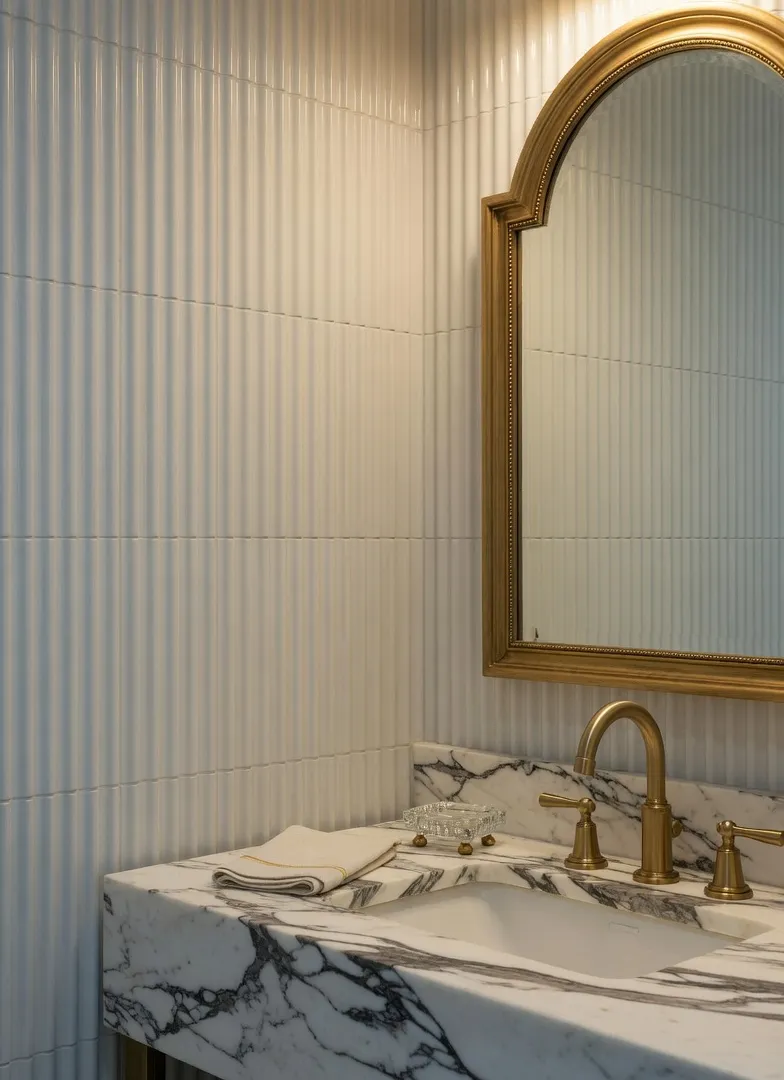
A Neo Deco bathroom applies the geometric language of 1920s–1940s Art Deco to contemporary design thinking — keeping structure while subtracting ornamentation. Instead of gilded surfaces and intricate motifs, Neo Deco uses fluted tile, satin brass, naturally veined stone, and controlled symmetry to create visual depth without visual clutter. The result is a bathroom that feels both distinctive and considered, glamorous without being theatrical.
Art Deco in the 1930s was about display. Gilding, inlaid ivory, crystal chandeliers that brushed the floor. You walked in and felt like you were standing in a Prohibition-era hotel lobby.
Neo Deco doesn't want that. It wants the spirit of Art Deco — geometry, symmetry, materials with visual weight — with the performance stripped out.
Archiproducts described the distinction well in early 2026: where Art Deco works by adding, Neo Deco works by subtracting. Decoration becomes graphic gesture. Surfaces are simplified. Color palettes are more controlled. The focus shifts from objects to proportion and spatial rhythm.
In a bathroom, that translates to something specific. A run of fluted tile from floor to ceiling instead of a full mosaic wall. A satin brass faucet instead of a full gold-plated hardware suite. An arch mirror or strongly geometric frame instead of a frameless rectangle. The restraint is the point — and the bathroom, with its fixed elements and limited surface area, is actually the ideal room for it.
Why the Bathroom Is Actually Where Neo Deco Works Best
This sounds counterintuitive. The bathroom — small, full of fixed points (toilet, tub, sink, vanity) — seems like the wrong place for a style that relies on proportion and rhythm.
But that's exactly why it works.
The bathroom doesn't have the competing objects a living room does. No sofa, no coffee table, no bookshelf pulling in multiple directions. The primary elements are walls, floor, plumbing fixtures, and light. Neo Deco performs best when it has fewer elements to manage — it needs clarity to land.
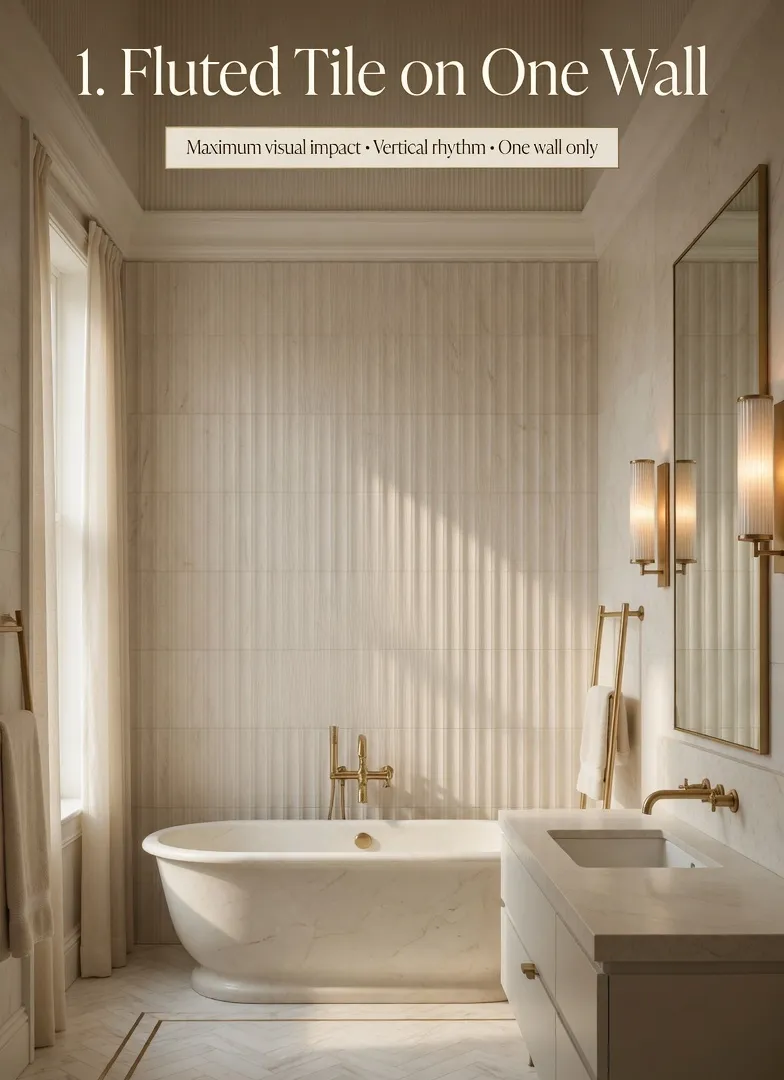
One fluted tile wall behind the tub, with a brass faucet and warm directional lighting from above — that's a complete aesthetic statement. Nothing else needed. In the bathroom, fewer objects means each decision carries more weight. And in Neo Deco, that's exactly the point.
Materials: What Looks Good vs. What Actually Holds Up
This is the section most Neo Deco articles skip entirely. Listing materials is easy. Explaining which ones genuinely survive a bathroom environment long-term while keeping their aesthetic — that's harder.
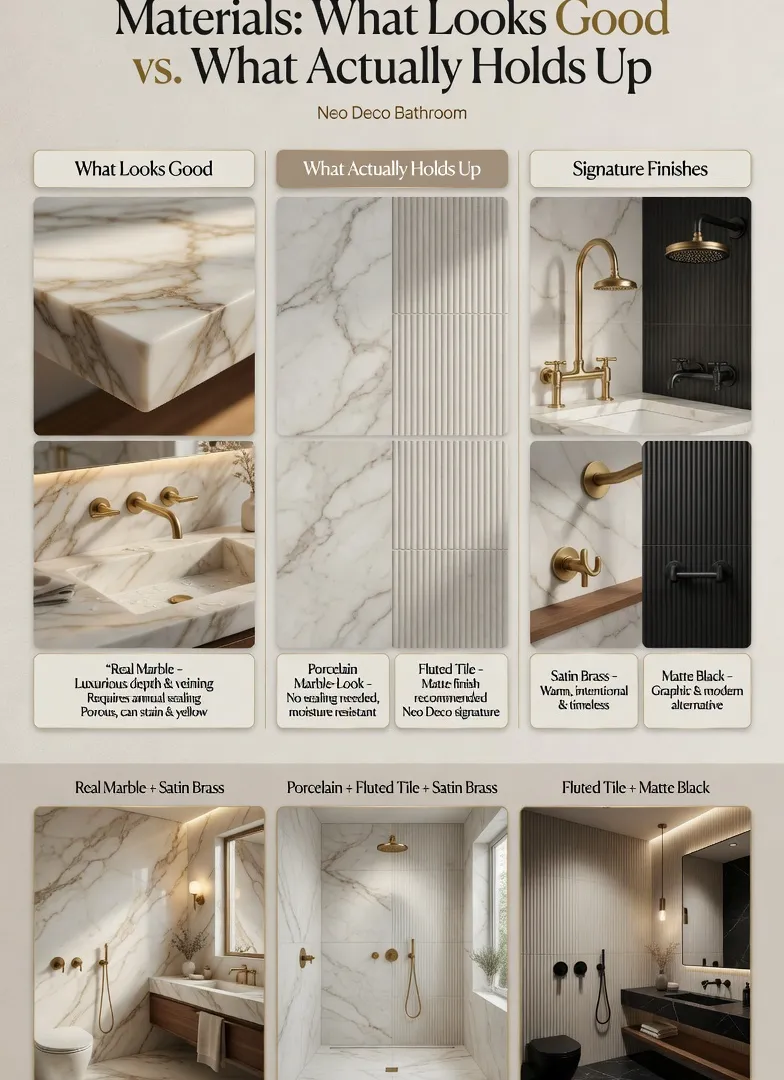
Real marble is the defining material of Neo Deco's visual language. Natural veining, visible weight, a way of catching light that no engineered surface quite replicates. But real marble in a bathroom requires sealing — at minimum once a year — because it's porous and absorbs moisture easily, particularly around faucets and in grout joints. Skip that maintenance and marble yellows, stains, and fades within two years. If you're not ready for that upkeep, real marble will disappoint you. Expect to pay $15–30 per square foot for mid-grade marble, and budget installation separately.
Porcelain with marble-look printing is the practical answer for most residential bathrooms. Digital glazing technology has reached the point where the veining pattern is genuinely difficult to distinguish from the real thing at arm's length. No sealing required, strong moisture resistance, consistent durability. The one honest trade-off: it lacks the depth of light that real marble has — the way stone seems to glow slightly from within. In a small bathroom under artificial light, most people can't detect the difference. In a larger, well-lit space with natural light, it becomes more apparent.
Fluted tile — tile with vertical ridges along the face — is currently the most recognizable architectural marker of Neo Deco. The ridges create vertical visual rhythm and, combined with directional light, cast shifting shadow lines as the day progresses. Specify matte or semi-matte finish for bathrooms. Gloss-finish fluted tile shows fingerprints and water marks in ways that will drive you to clean it daily.
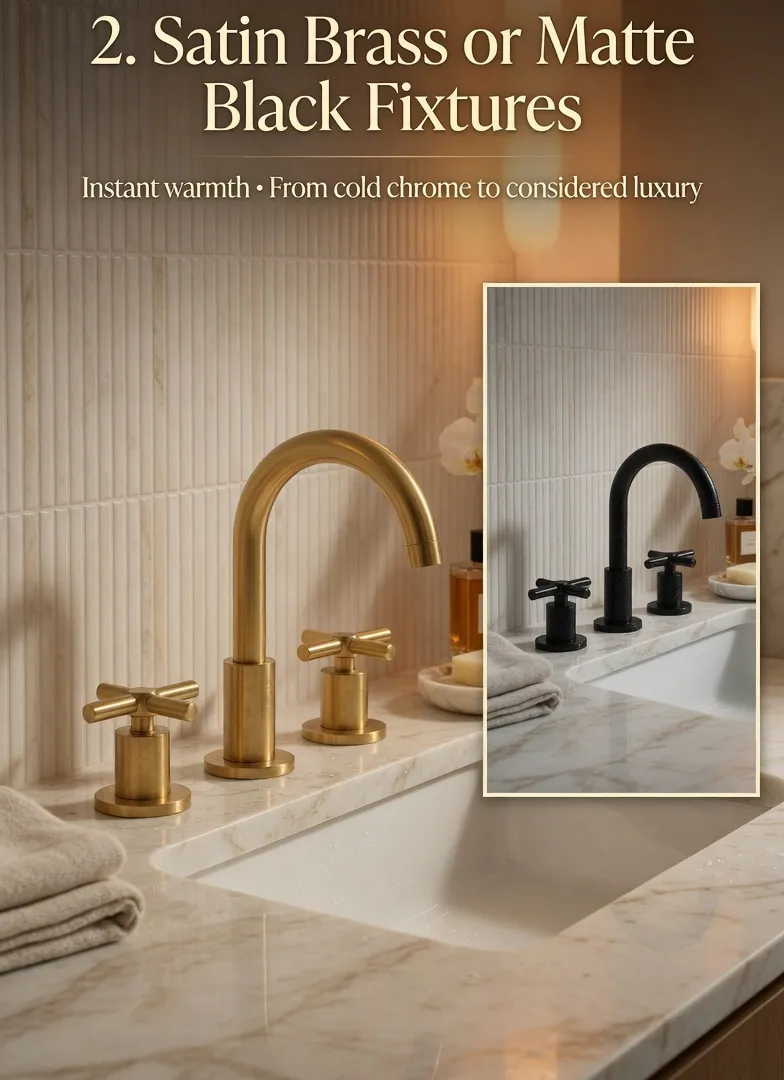
Satin brass fixtures are the Neo Deco signature finish — not the bright polish brass of the 1980s, and not cold chrome minimalism. Satin brass reads warm and intentional, holds up with marble, fluted tile, and dark wood, and ages well. Matte black is the other Neo Deco finish, creating something colder and more graphic. Both work; they produce different emotional registers. Grohe, Hansgrohe, and Kohler all have solid mid-range options in satin brass. For something more bespoke, Waterworks and Kallista offer custom configurations.
Color — It's Not Just About Going Dark
There's a common misread: Neo Deco = dark palette = navy, black, deep espresso.
That's not wrong. But it's incomplete.
Neo Deco works across three distinct palette approaches, and in the bathroom — where natural light is often scarce — which approach you choose matters more than in almost any other room.
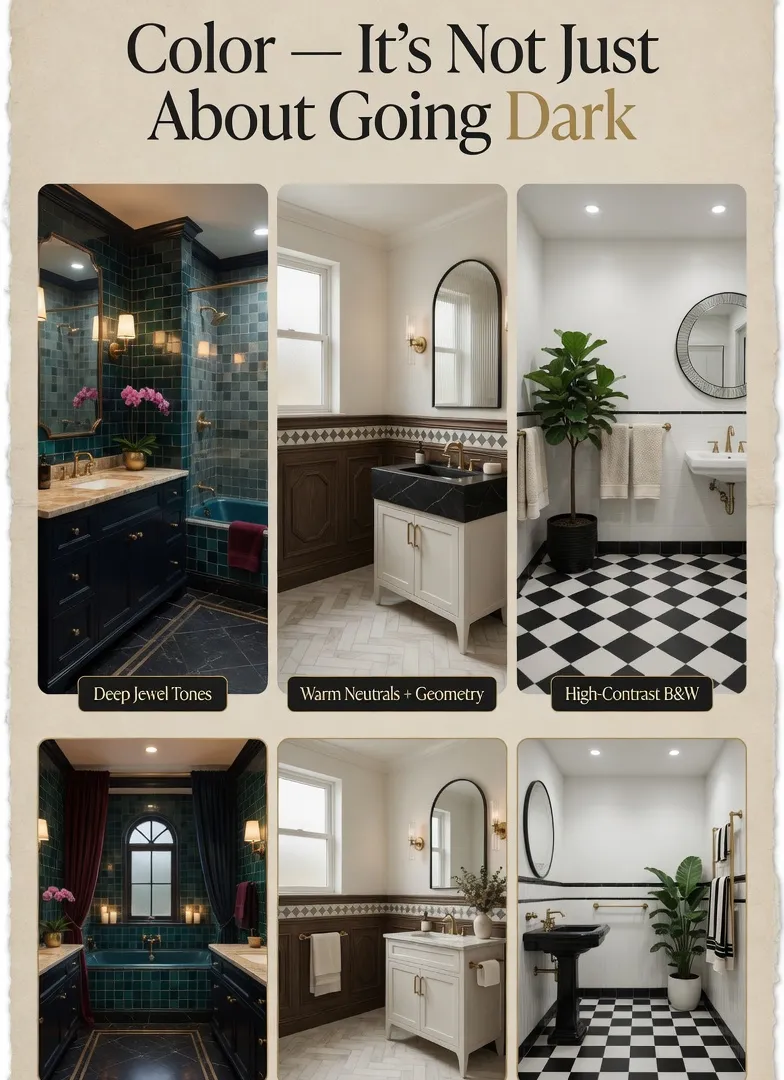
Deep jewel tones — peacock teal, emerald, burgundy, near-black navy — create the "cave-like luxury" Neo Deco is known for. This palette works best when the bathroom has at least one strong warm light source (warm white, under 2700K) or access to natural light. Emerald tile under cool white overhead lighting (4000K or above) reads institutional rather than moody. The color is doing the right thing; the lighting is undoing it.
Warm neutrals with geometric accent — warm white, cream, greige as a base, combined with one strong geometric move (herringbone tile in a contrasting tone, dark wood boiserie, a black-framed geometric mirror) — is the more breathable approach, and more practical for smaller bathrooms or those without windows. Pantone's 2026 Color of the Year, Cloud Dancer — a warm, slightly weightless white — actually fits Neo Deco this way surprisingly well. It gives the architectural details room to read.
High-contrast black and white — checkerboard floor, white walls, matte black or brass fixtures — is the most graphic Neo Deco variation, and the one closest to the original Art Deco visual language. It's also the easiest to get wrong. If the checkerboard scale doesn't suit the room size, or if nothing softens the contrast (a plant, warm-toned towels, a piece of art), the space reads like a 1960s public restroom. The tile scale matters: 4x4-inch checks in a 50-square-foot bathroom are different from 12x12-inch checks in the same space. The smaller the room, the smaller the check.
Three Architectural Details That Do Most of the Work
If you only want to make one change to bring a bathroom into Neo Deco — here are the three options, ranked by visual impact.
Fluted tile on one wall. Not all four. Just the wall behind the tub or behind the vanity — floor to ceiling if possible. Fluted tile creates vertical rhythm, pushes perceived ceiling height, and makes a clear aesthetic statement in a way that flat tile simply can't. The color doesn't have to be dark — off-white, warm cream, and pale sage all work. What matters is the texture and the vertical direction.
Satin brass or matte black fixtures. Swapping chrome faucets for satin brass changes the entire thermal register of the room. Chrome reads cold and clinical. Satin brass reads warm and considered. A single faucet swap for the vanity — around $200–600 for a quality mid-range option — shifts the whole palette of the bathroom toward Neo Deco without touching a single tile.
A geometric mirror. An arch mirror (flat bottom, curved top), an octagonal mirror with a black or brass frame, or a rectangular mirror with a thick-profile frame are all Neo Deco vocabulary. This is the change that requires no renovation at all, and in a bathroom where the mirror is often the first thing your eye goes to — the aesthetic impact is disproportionate to the effort.

Lighting: The Part Everyone Plans Last But Should Plan First
A specific reality about Neo Deco bathrooms: the jewel tones that look incredible in design photos look that way because those photos were taken under the right light. Emerald tile under a single overhead cool-white fixture looks like a bus station bathroom. Under warm, angled light at 2700K — it becomes the moody, rich environment you were looking for.
A Neo Deco bathroom needs at least two light sources: task lighting (for the mirror, for the vanity) and ambient lighting that creates mood. Concealed LED strip lights behind the mirror or under floating cabinets are the easiest way to add ambient light without visual clutter. Temperature: 2700K across the board. No exceptions.
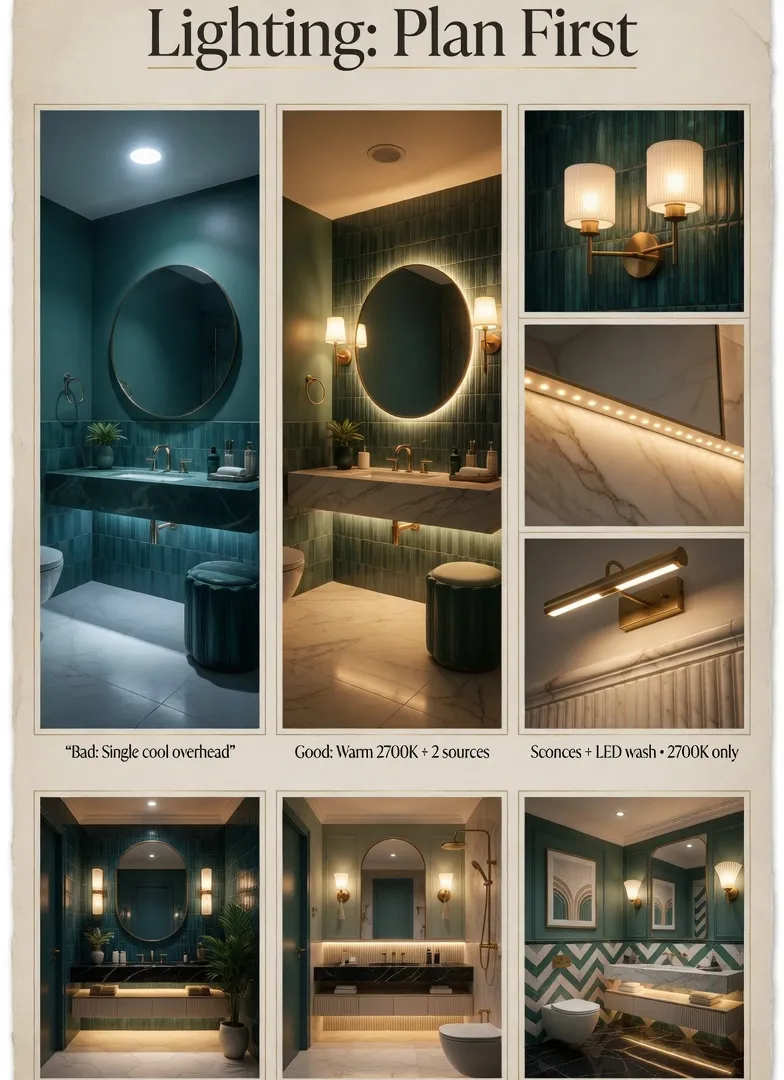
The mistake most people make: a single overhead recessed light centered in the ceiling. Overhead light casts hard downward shadows and flattens all texture — even the best fluted tile becomes visually dull under straight-down illumination. Neo Deco needs light with direction. Wall sconces flanking the mirror, a directional overhead that can be angled, or concealed strips that wash the wall — any of these work better than a single ceiling can.
Small Bathrooms and Neo Deco — Can It Work?
The direct answer: yes, with conditions.
Neo Deco in a tight space means selecting fewer elements and making each one count. One fluted tile wall — not four. One brass fixture — not a full suite. One geometric mirror — not a gallery of smaller mirrors plus floating shelves.
Archiproducts specifically warns against this in smaller environments: too many reflective surfaces (gloss tile, multiple mirrors, polished chrome) combined with heavy geometric pattern creates spaces that feel like they're competing with themselves rather than cohering. One large arch mirror bouncing light through a small bathroom does more work than three smaller mirrors arranged in a grouping.
On flooring: for bathrooms under 50 square feet, large-format tile (24x48 inches or larger) is a better choice than geometric patterning. Fewer grout lines, less visual fragmentation, the room reads larger. Herringbone and checkerboard — both core Neo Deco patterns — work better in bathrooms of 50 square feet or more, where the eye has enough surface to read the rhythm of the pattern rather than just registering visual noise.
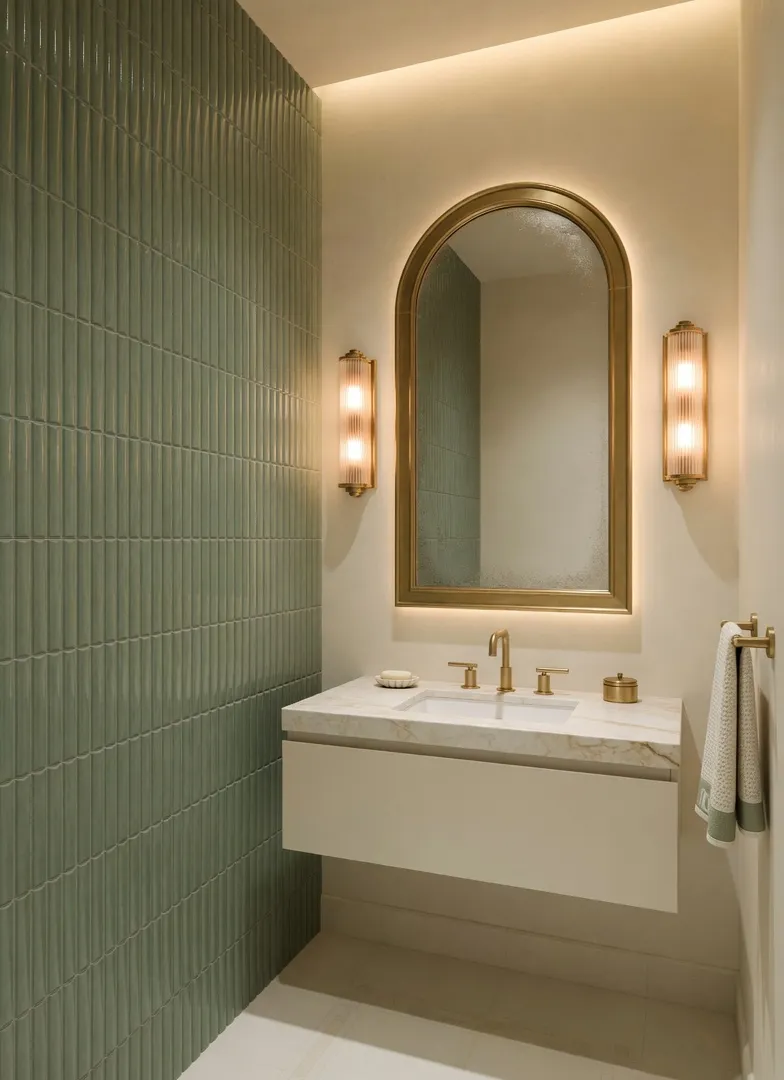
If you want to start somewhere: change the mirror first.
An arch mirror with a black or satin brass frame — placed over whatever wall you currently have, whatever color — immediately introduces Neo Deco language to the room without demolition, without significant spend, and without commitment. Once it's there, the rest of the room will show you clearly what needs to shift to follow.
That's how Neo Deco works best. Not a full renovation from day one, but one right decision that makes the next decision obvious.
Frequently Asked Questions
About the Author: Elena Vance
Interior design enthusiast and DIY expert. Elena Vance has spent over a decade curating spaces that blend modern aesthetics with everyday functionality. Passionate about helping you create a home that tells your unique story.
