
10 Biophilic Small Space Ideas 2026: Transform Your Tiny Apartment into a Serene Nature Sanctuary


Most people think biophilic design means buying more plants.
It doesn't. Or — it does, but that's only one layer of a much more considered approach, and honestly not always the most important one. Biophilic design is about recreating specific inputs that our nervous systems are wired to respond to: fractal patterns, natural light cycles, organic shapes, the sounds and smells of living things. We spent 99% of human history surrounded by all of these simultaneously. We now spend over 90% of our time indoors. The body hasn't forgotten what the modern schedule has.
The research backs this up in ways that go well beyond "plants make you feel better." Studies published in Scientific Reports in 2025 found that even a medium-sized living wall measurably increased physiological relaxation during cognitively demanding tasks — tracked through heart rate variability, not self-reported mood. A broader review of 203 peer-reviewed studies, published in Discover Environment in 2026, confirmed that biophilic design consistently reduces physiological stress markers, improves attention, and accelerates cognitive recovery. These aren't soft benefits. They're documented and measurable.
The harder question is: which biophilic elements actually do that — and which ones mostly just look good in photos?
These 10 ideas are real. But each comes with the context most articles skip: what it actually does, how to apply it well in a small apartment, and where it goes wrong.
1. Modular Vertical Living Walls That Turn Blank Walls into Forests
A living wall is the most dramatic biophilic move you can make in a small space, and it comes with the most important caveat: it's also the easiest thing to kill.
Here's what the articles don't tell you. The 2025 Scientific Reports study on living walls found genuine physiological benefits — measurable relaxation response, not just reported preference. But the plants in that study were alive and healthy. A dying or struggling living wall isn't just not beneficial; it's actively stressful. Brown leaves and wilting stems are visual cues that read as "something is wrong here," and your nervous system responds accordingly.
So before the aesthetics, think about light. A felt-pocket or hydroponic living wall in a north-facing apartment without supplemental grow lights is going to struggle, and it's going to show. The species that genuinely thrive in low light — pothos (Epipremnum aureum), heartleaf philodendron, golden pothos — should be your starting point, not ferns, which want humidity and indirect brightness that most apartments can't reliably provide.
Self-watering systems with app alerts help, but they don't solve a light deficit. If you don't have strong natural light and aren't willing to add a grow light strip above the panel, consider idea #2 instead.
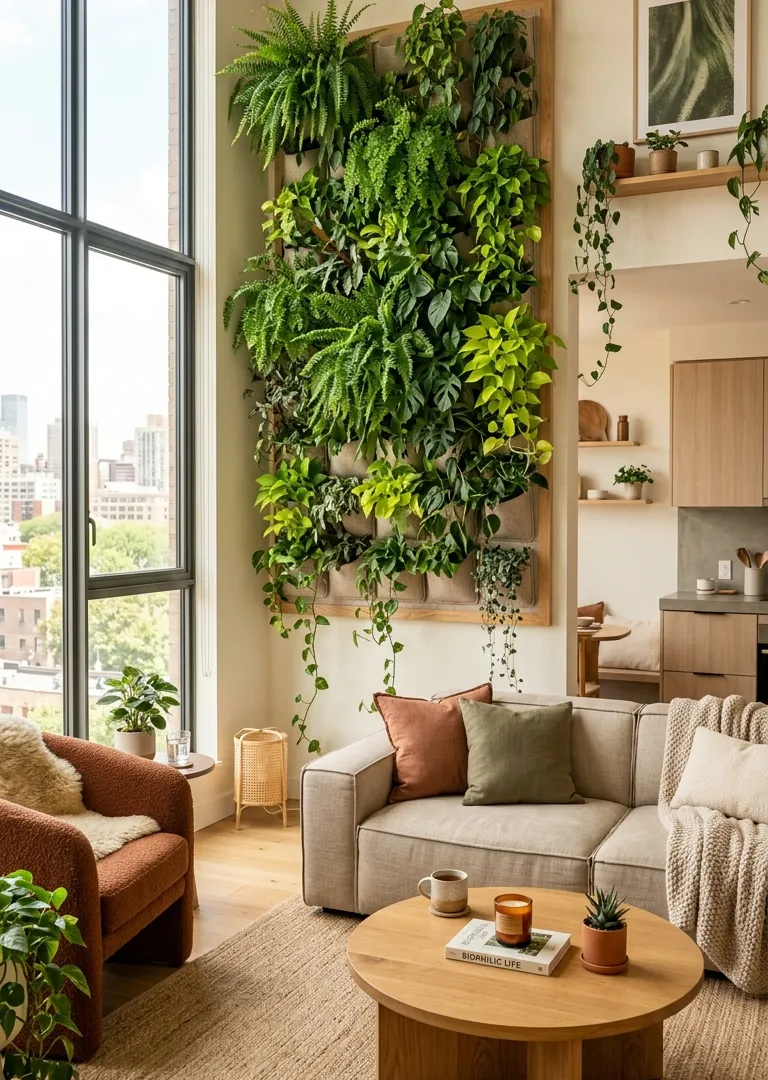
If your light is good: A 4×3 ft felt-pocket panel above the sofa works beautifully. Keep it to two or three species with similar water needs — mixed panels fail because one section always dries out before another needs watering. Budget roughly $150–400 for a quality DIY panel kit; professional installation runs $35–150 per square foot depending on the system complexity.
If your light is limited: Start smaller. A single hydroponic column in the corner of a room with a dedicated grow light gets you most of the visual and air-quality benefit at a fraction of the maintenance risk.
2. Air-Purifying Moss Panels as Living Artwork
If the living wall is the high-maintenance option, the moss panel is its sensible sibling — and for many small apartments, it's actually the better choice.
Preserved moss is real moss that's been treated with a glycerin-based solution to maintain its color and texture indefinitely without soil or water. No watering, no grow lights, no drainage concern for the apartment below you. The maintenance commitment is essentially zero. That matters.
But beyond the practical appeal, moss panels do something most wall decor doesn't: they absorb sound. The fibrous, irregular surface of moss is acoustically similar to soft furnishings — it breaks up sound waves and reduces echo in ways that flat walls and artwork don't. In a small apartment where noise from the city or neighbors is a constant low-level stressor, that acoustic dampening has real quality-of-life value.
The humidity regulation claim is real too, though modest. Moss panels do buffer small fluctuations in relative humidity — they absorb moisture when the air is humid and release it when it's dry. In a well-sealed apartment with forced-air heating in winter, that small buffer matters more than you'd think. Dry air at 30% relative humidity is a known sleep disruptor; anything that nudges that number up helps.
Pair a 24×18 inch framed panel with a reclaimed oak or walnut frame and hang it at eye level near where you spend the most time — above the desk, beside the reading chair, in the entryway. The green against warm wood grain hits the same biophilic pattern recognition that views of nature from a window do: fractal irregularity, earthy color, organic texture.

3. Vertical Herb Gardens on Windowsills or Tiny Balconies
Here's a distinction that most biophilic design articles gloss over: passive vs. active engagement with nature.
Passive biophilia — a plant in the corner you water once a week, a moss panel on the wall — delivers the visual and atmospheric benefits just by existing. But research on Attention Restoration Theory suggests that interacting with natural elements, even briefly, generates a deeper restoration effect. That's the science behind shinrin-yoku (forest bathing): it's not just looking at trees, it's moving through them, touching bark, smelling damp soil.
An herb garden gives you daily active contact. You pinch off basil leaves for dinner. You bruise a mint stem with your fingers on the way past. You notice when something needs water. These small tactile, olfactory interactions are exactly the kind of multi-sensory engagement that the research points to as most restorative. And you get fresh herbs.
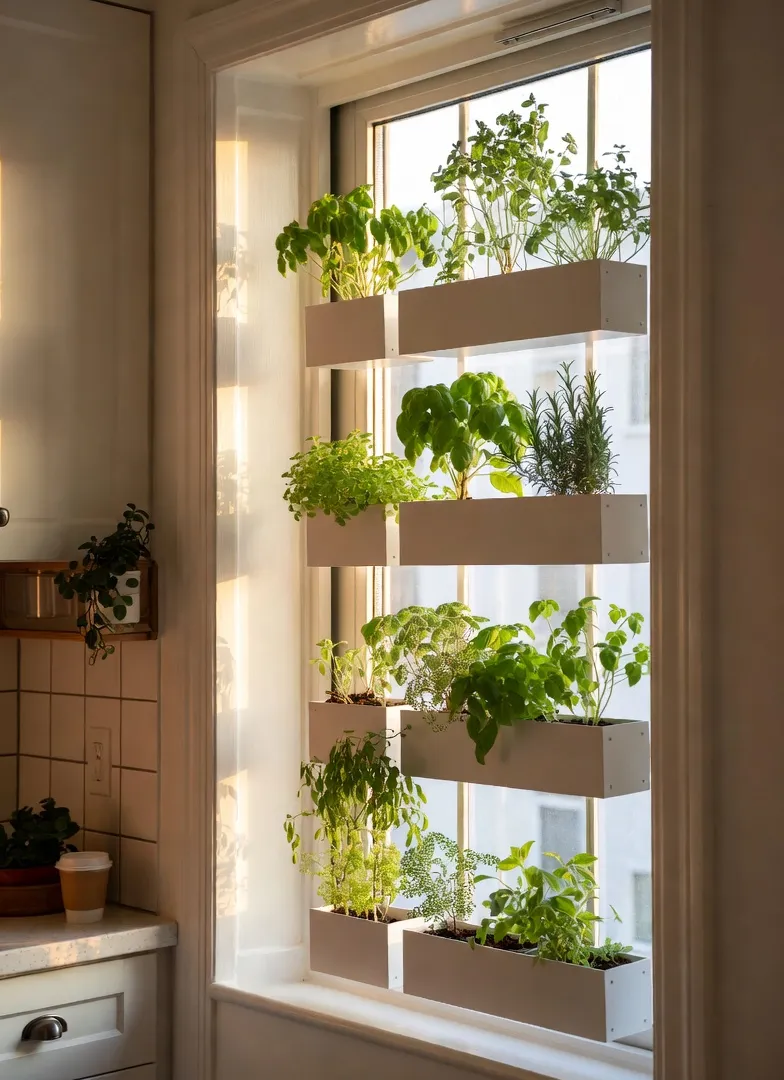
For small apartments, vertical is non-negotiable. A stackable hydroponic tower system with its own reservoir and a small integrated grow light fits in about 12 inches of floor depth and handles four to six plants. The no-drill suction-cup rail versions that mount inside window frames work well for renters and handle three or four pots comfortably.
Herbs with the strongest sensory payoff for biophilic purposes: basil (strong scent, fast growth — visually rewarding), mint (nearly impossible to kill, intensely aromatic when touched), rosemary (woody scent, drought-tolerant, looks architectural). Avoid cilantro unless you cook with it constantly — it bolts to seed fast and looks defeated.
4. Circadian Smart Lighting + Oversized Mirrors for Maximum Natural Light
Light is the biophilic intervention with the most direct physiological mechanism — and the most commonly misapplied.
The body's circadian clock runs on light. Specifically, it runs on changes in the color temperature and intensity of light across the day: cool and bright (high blue content) in the morning, warm and dim (low blue content) in the evening. Modern apartments with static artificial lighting disrupt this cycle every day, every season. The result accumulates slowly — disrupted sleep, suppressed melatonin, elevated baseline cortisol.
Circadian smart bulbs that shift from around 5500K at 7am to 2700K by 8pm address this directly. The LIFX or Philips Hue Gradient bulbs do this automatically once programmed. The effect on sleep quality, reported within two to three weeks of consistent use, is significant enough that this is probably the highest-return biophilic upgrade most apartments can make.
But there's a second, simpler move: the mirror.
Placing a large floor-leaning mirror — 60 inches or taller — on the wall directly opposite your best window effectively doubles the daylight entering the room. The mirror reflects the actual view of the outdoors, not just diffuse light. That matters because looking at a reflected view of sky and greenery activates the same stress-reduction pathway as looking at a direct view. Studies on hospital patients (Roger Ulrich's foundational 1984 research in Science) found that even views of trees — not being outside, just viewing them — measurably reduced pain medication use and shortened recovery times.
Your leaning mirror is doing a version of that. Don't underestimate it.
One caution: in an apartment with very limited natural light (north-facing, heavily shaded), mirrors alone can't manufacture what isn't there. Pair them with a full-spectrum LED grow light strip above your plant shelf and circadian bulbs in your main fixtures, and you've built a decent substitute.

5. Cocooning Wellness Nooks with Trailing Plants & Organic Curves
Biophilic design isn't just about what you add to a room — it's also about the structure of space. One of Terrapin Bright Green's foundational "14 Patterns of Biophilic Design" is the concept of "refuge": spaces that feel enclosed and protected while still offering a view outward. Think of the back of a cave, or a spot under a tree with open sightlines.
Small apartments can't always create rooms within rooms. But a nook does something close.
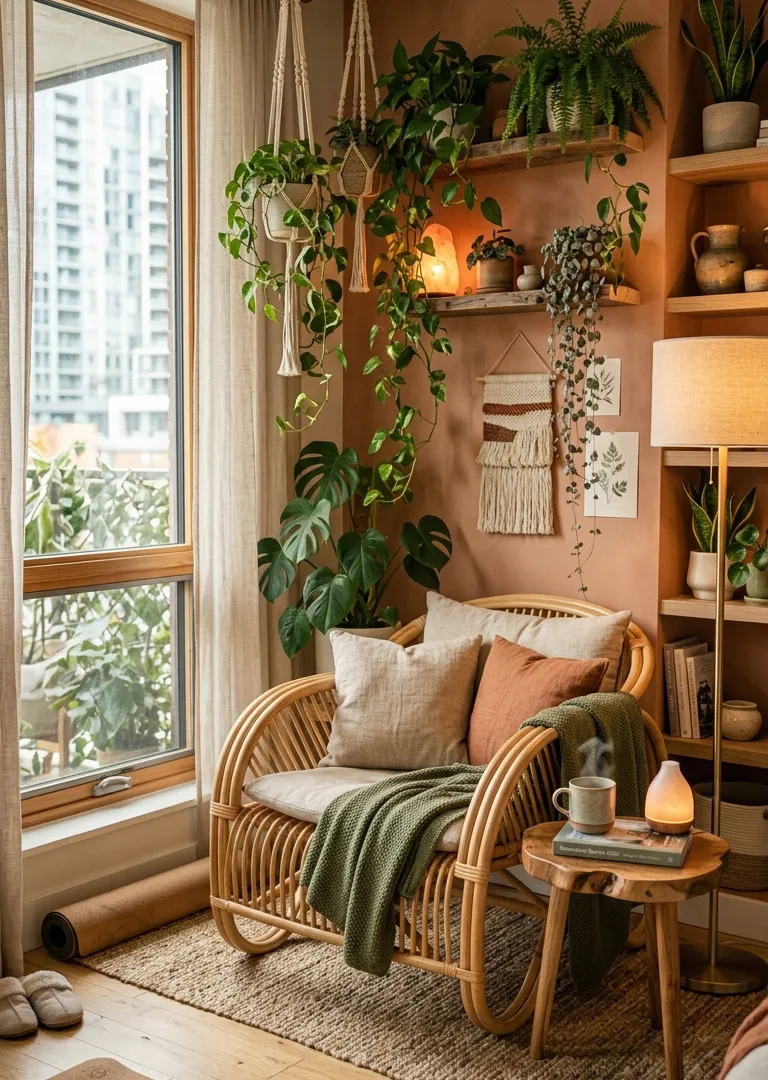
A curved rattan or wicker chair in a corner, with a tall plant to one side and something overhead — a shelf with trailing plants, a macramé panel, a canopy of fabric — creates a defined micro-environment. The key word is "defined." The boundary signals to your nervous system that this space has different rules from the open-plan living area. It's a refuge.
The plant choices here matter. Trailing plants — pothos, string of pearls, heartleaf philodendron — work better than upright plants in this context because they create a sense of natural canopy overhead and around the sides. That enveloping quality reinforces the refuge feeling that makes the nook restorative rather than just decorative.
An indoor olive tree (Olea europaea) as a companion piece adds height, a distinctive silhouette, and the subtle grassy-herbal scent that olives carry. They want bright indirect light and dry-ish conditions between waterings, which makes them more forgiving than most statement plants. They grow slowly, which means they don't quickly outgrow the space.
For renters who can't use a room divider: a tall bookshelf with plants on top, angled slightly toward the corner, creates the same boundary effect without any drilling.
6. Biomorphic Furniture with Built-in Planters
This idea operates on a principle that's worth naming: biomimicry.
The first category of biophilic design is "nature in the space" — actual plants, water, natural light. The second is "natural analogues" — materials, patterns, and forms that evoke nature without being nature directly. Both activate the same restorative response, because the brain's pattern recognition system doesn't distinguish between a real tree branch and a convincingly organic wooden curve. It reads the shape and responds accordingly.
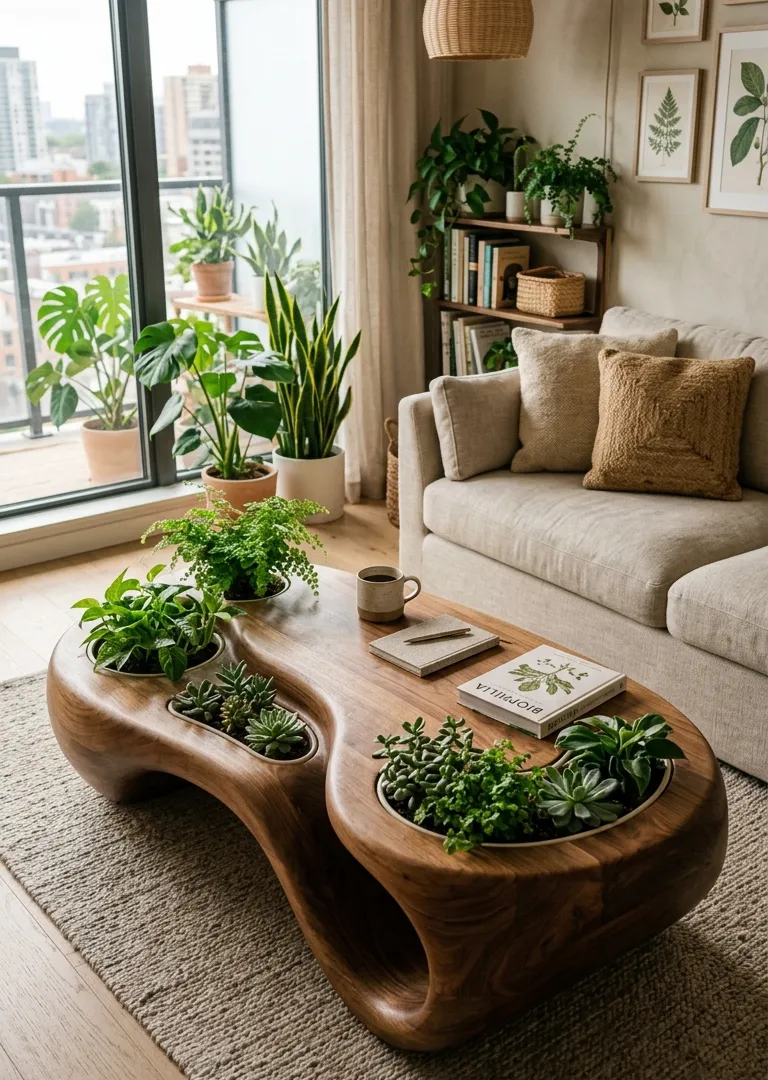
Furniture with biomorphic shapes — wavy edges, asymmetric silhouettes, organic curves — is natural analogue biophilia. It works. But furniture with integrated planters adds the actual green element at the same time, which compounds the effect. The visual message is seamless: the living thing and the human-made object belong to each other.
The functional benefit in small spaces is real too. A wavy walnut console with a succulent or small succulent garden growing through a pocket in its surface doesn't require additional surface area for a planter. It's one footprint doing two jobs.
What to look for in this category: pieces made from solid wood or FSC-certified reclaimed wood rather than MDF with wood veneer. The grain and natural imperfection of real wood is itself a biophilic texture — it has the subtle irregularity that the brain reads as organic rather than manufactured. MDF with veneer is flat-looking under close inspection, and that visual cue matters.
7. Mini Indoor Water Features for Sound & Humidity
Sound is the most underutilized channel in home biophilic design.
Every other idea on this list is primarily visual. But water — specifically flowing water — gives you something the others don't: an auditory input that directly activates the parasympathetic nervous system. The sound of moving water has been documented across multiple studies to lower heart rate and blood pressure. It's not relaxing because you associate it with relaxing places; it's relaxing at a neurological level, in the same way that certain wavelengths of light trigger specific hormonal responses.
The practical version of this in a small apartment is a tabletop fountain. Modern ones are quiet enough that you don't notice the pump — only the water sound. The critical spec to look for is the flow rate: a gentle trickle that sounds like a shallow brook is restorative; a splashing cascade that sounds like a leaking pipe is not. Read reviews specifically for "noise" before buying. Models from the $40–120 range at Amazon and IKEA are hit or miss; the Teamson Home and Kenroy Home tabletop fountains in the $80–150 range have more consistent reviews for quiet operation.
One genuine benefit that doesn't get mentioned enough: humidity. Tabletop fountains add a small amount of moisture to the air through evaporation — not dramatic, but meaningful in a dry forced-air apartment in winter. Peace lilies (Spathiphyllum), which the original article mentions correctly, genuinely do love the extra moisture around a fountain. They also tolerate low light better than most flowering plants. Place one beside the fountain rather than across the room.
The failure mode: forgetting to clean the basin. Stagnant water in the reservoir grows algae within two to three weeks and starts to smell. A small amount of white vinegar in the water slows this considerably. Cleaning once a month keeps it sustainable.

8. Layered Natural Textures in Warm Earth-Rooted Palettes
This one doesn't need a plant. And that's worth saying clearly, because biophilic design is often mistakenly treated as synonymous with indoor gardening.
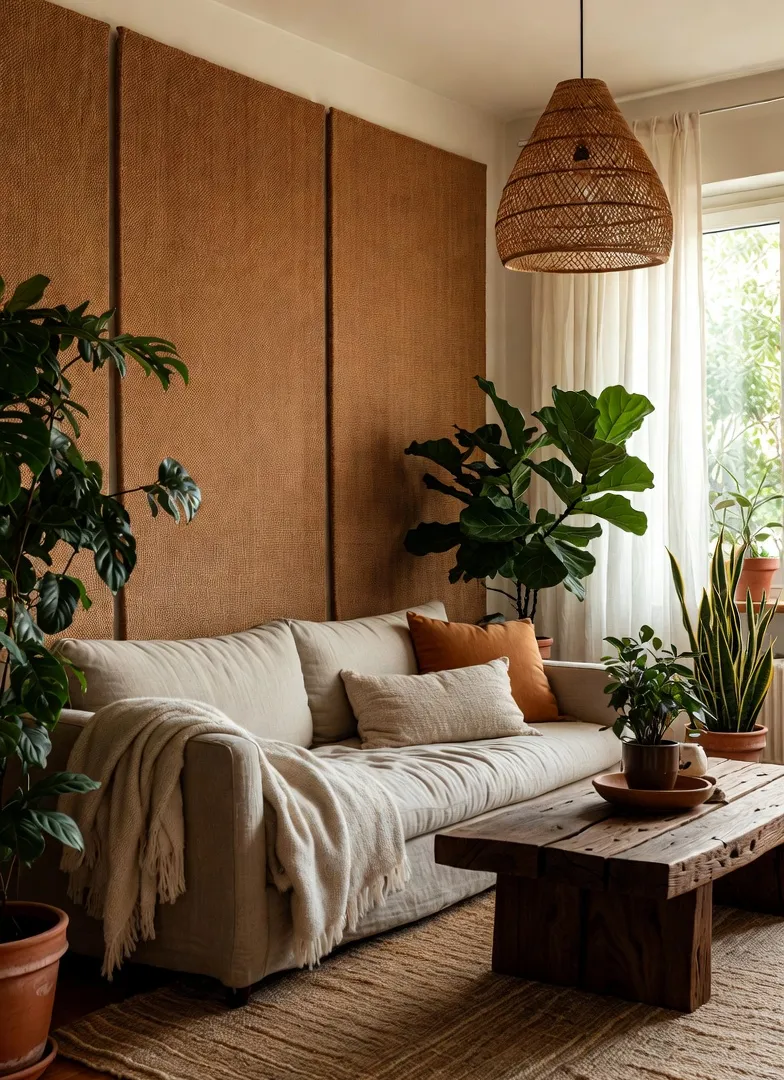
Natural materials — linen, jute, raw wool, unfinished wood, honed stone, raw plaster — carry biophilic value because of their texture, not just their color. The science term is "fractal fluency": natural surfaces have irregular patterns that repeat at different scales (the grain of wood, the weave of linen, the roughness of stone). The brain processes fractals with exceptional ease and low cognitive load, which is experienced as calm. Uniform synthetic surfaces — flat-painted walls, smooth plastic, high-gloss lacquer — offer no fractal input and generate a very mild but persistent cognitive tax.
A room textured with natural materials is genuinely restful in a way that a room textured with synthetics isn't, even when both look clean and composed.
The palette that compounds this effect: warm earth tones. Not because brown is inherently calming, but because these pigments — warm terracotta, dusty sage, raw umber, warm linen — are the colors of the natural world our eyes evolved to read as safe and resource-rich. Neuro-aesthetics researchers describe this as the "safety signal" palette. Synthetic equivalents of these colors (a bright Pantone orange, a neon green) don't carry the same signal because the saturation and brightness are wrong.
For small apartments, the hierarchy of impact: a large wool or jute area rug first (most visual real estate, biggest textural contribution), linen or cotton blend curtains second, one boucle or chunky knit throw third. You don't need all three immediately. The rug alone shifts the room's register.
The color palette that works most reliably: warm cream walls as a base, one terracotta accent (a single ceramic vase, a throw), dusty sage in a plant or a second textile. Three tones maximum. The restraint is what makes it work.
9. Sensory Nature-Inspired Art & Fiber Installations
This is the most accessible biophilic idea on the list for renters who can't make structural changes — and the one most people don't think of.
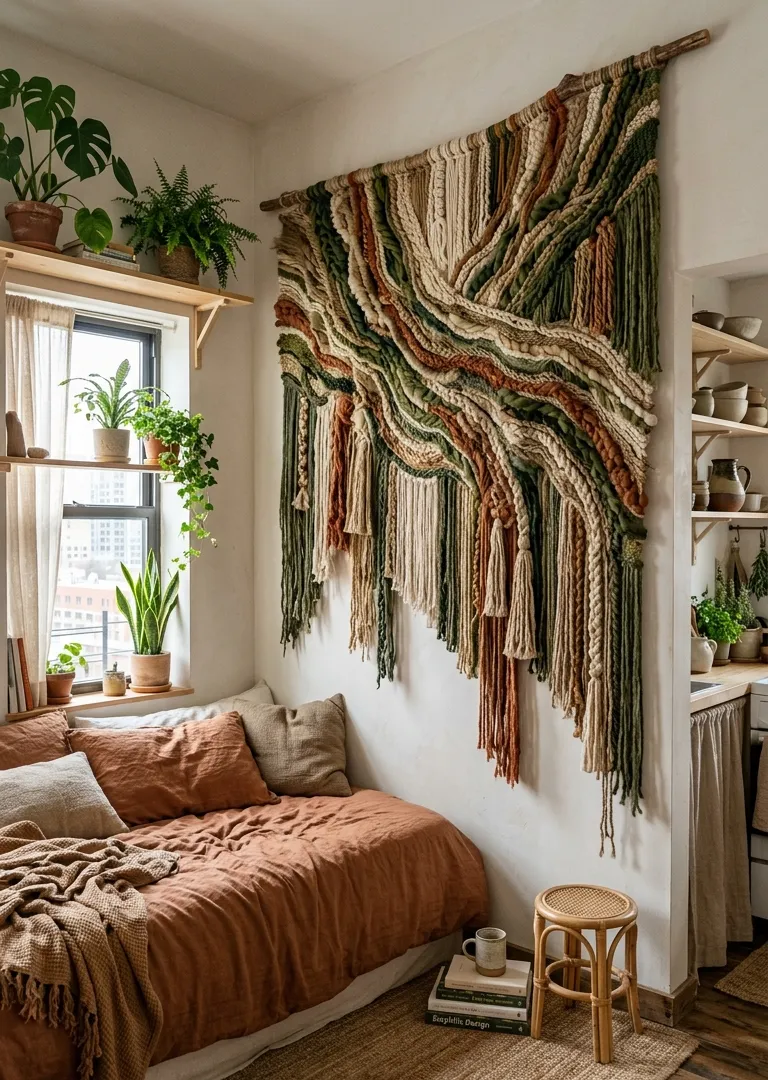
The principle is biomimicry again. A large fiber art piece made from undyed wool, dried grasses, jute, or cotton in organic forms isn't a substitute for a plant — it's a different kind of biophilic input, targeting the visual pattern recognition system rather than the olfactory or atmospheric channels. The brain reads the irregular, layered texture of handmade fiber as organic, not manufactured. That reading generates a mild but real restorative response.
Printed botanical posters don't do this. The image content might suggest nature, but the flat, uniform surface of a print doesn't carry the textural signal. Fiber art does, because the texture is physically there: light catches differently on different angles of the fiber, the piece moves subtly with air currents, the shadow patterns change through the day.
Size matters here more than detail. A 12×16 inch piece looks like a craft project. A 36×48 inch piece that takes up a significant portion of the wall above a sofa or bed reads as a visual anchor for the whole room. Etsy has a healthy market of independent fiber artists working in this category; budget roughly $150–400 for a large, quality piece in natural, undyed materials. The undyed-materials detail is important: synthetic dyes introduce visual saturation that breaks the organic palette.
Pressed botanicals in large, simple frames work similarly and at lower cost — they have real plant material, which retains some of the irregular texture of leaves and stems even flat.
10. Smart Self-Watering Plantscapes with Integrated Tech
The tech angle here is genuinely useful, not just a 2026 buzzword.
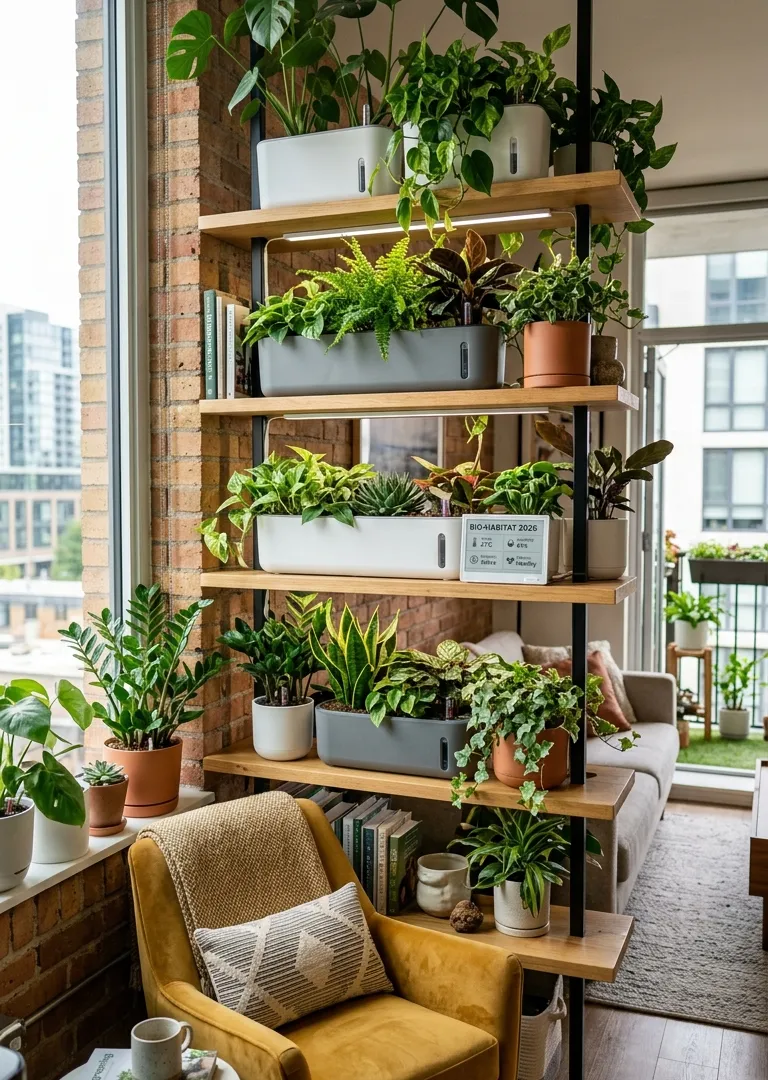
The reason most apartment plantscapes fail isn't poor intention — it's inconsistent watering. Self-watering planters with a reservoir you top up every ten to fourteen days remove that variable almost entirely. You're no longer trying to remember which plant needs water today; you're checking a single water level once a fortnight. The plant group lives or dies as a system rather than as a collection of individual demands.
Paired with a discreet grow light strip mounted to the underside of the shelf above, this setup makes a darkish apartment viable for plants that would otherwise struggle. The grow lights don't need to be prominent — a 6500K LED strip (high blue content, which is what plants want for photosynthesis, distinct from what humans want for evening ambiance) angled down and hidden behind a shelf edge is nearly invisible.
The plant grouping that consistently performs well for this setup: snake plants (Sansevieria trifasciata) for low light tolerance and architectural form, peace lilies for air-purifying capacity (NASA's Clean Air Study consistently names them among the most effective, though effectiveness in typical room conditions is more modest than the 87% figure often cited), and pothos for cascading visual effect and near-indestructibility. These three have compatible water needs — relatively drought-tolerant — which means a single self-watering system works for all of them.
Varying the heights is visual intelligence, not just aesthetics. A plantscape at a single height reads as flat. Three heights — a tall snake plant at the back, mid-height peace lily, trailing pothos at the front edge — creates depth, which the eye reads as a mini-ecosystem rather than a set of pots on a shelf. That perception difference turns out to matter for how restorative the visual is.
How These 10 Ideas Work Together (And Where to Start)
The most common mistake with biophilic design in small apartments isn't choosing the wrong ideas — it's treating each idea as a separate decorating project rather than as layers of a single sensory environment.
Your nervous system doesn't experience a living wall separately from the texture of your rug or the temperature of your light. It takes all of them in at once. A room with a beautiful living wall, harsh fluorescent lighting, and a synthetic tile floor is sending mixed signals. A room with even modest natural elements — a few plants, a jute rug, warm light, one moss panel — that are all pointing in the same direction creates a coherent biophilic environment.
Where to start depends honestly on your light situation. That's the non-negotiable foundation. If you have good natural light, the living wall and the plant grouping will reward you. If your light is limited, circadian smart bulbs and the moss panel are higher-return starting points.
After light: texture. A large natural-fiber rug is the single highest-impact move for most apartments — it changes the acoustic and visual quality of the space simultaneously and doesn't require any maintenance. After that: one water feature or one fiber art piece, depending on whether sound or visual complexity is more appealing to you.
The herb garden and wellness nook can come whenever you're ready. They reward the most investment of attention — and that attention is itself part of the benefit.
About the Author: Elena Vance
Interior design enthusiast and DIY expert. Elena Vance has spent over a decade curating spaces that blend modern aesthetics with everyday functionality. Passionate about helping you create a home that tells your unique story.